
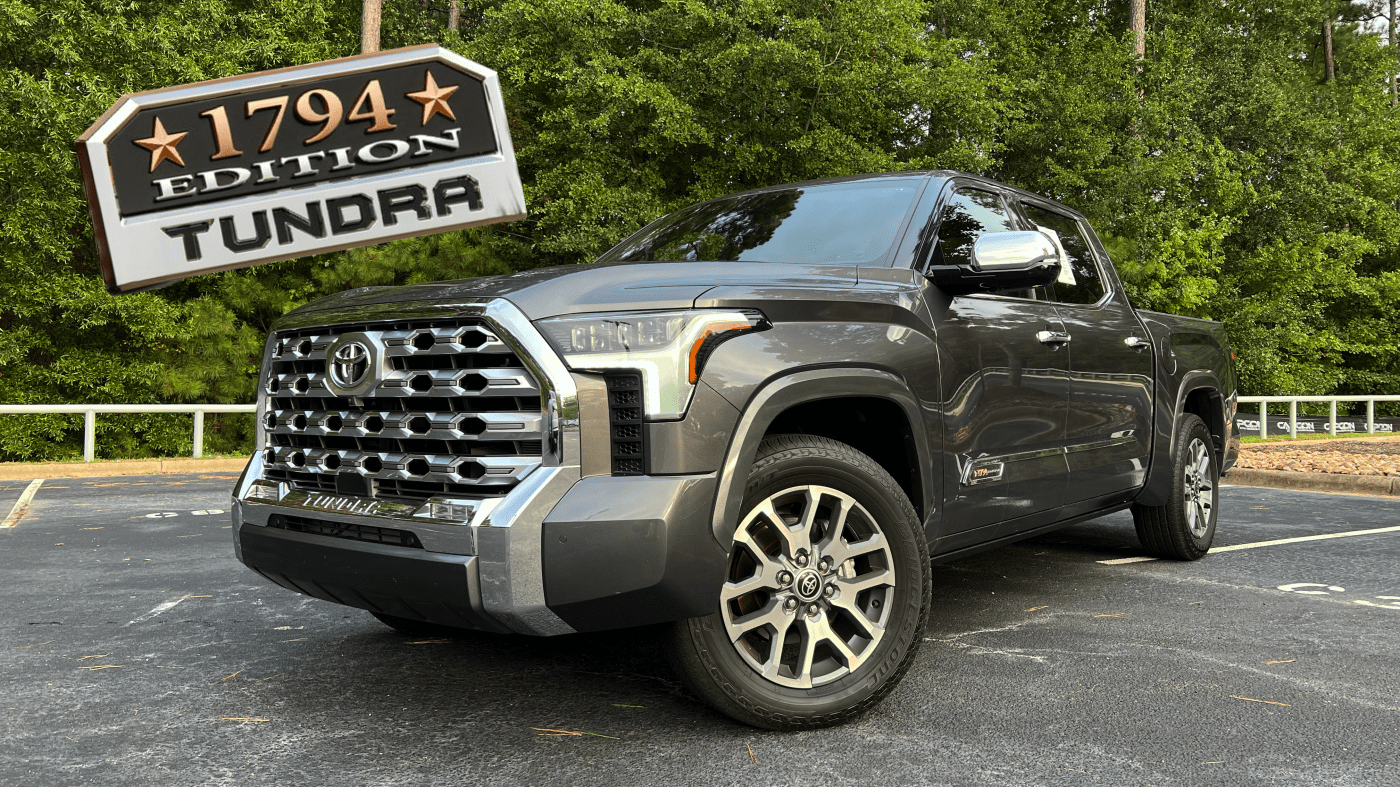
2022 was a big year for Toyota’s legendary Tundra pickup truck, bringing a complete redesign that featured new engine options, reworked suspension, and the most technology in a Tundra to date.
The exterior and interior design of the Tundra have been completely redone. My test truck was a 1794 Edition, the third highest in the range. 1794 features a few styling differences versus other models, such as the grille, wheels, extra chrome trim, and unique interior colors. The Tundra is an excellent looking truck in my opinion, although different trim options may significantly sway that statement either direction for most folks.
In terms of features, the 1794 is similarly equipped to the Platinum model. Both feature adaptive LED headlights, power folding mirrors, 10-way seats with memory, a panoramic sunroof, and all of the safety features you would expect for the price point. The optional power running boards and automatic bed step that were added to our truck were nice touches, as is the tailgate release mounted on the side of the taillight. Inside the bed, you’ll also find a power outlet and LED lighting. All 2022 Tundras have a composite bed, meaning the interior surface is not painted and therefore does not require the addition of a bedliner.
Stepping inside the truck, I must admit I’m a sucker for cognac or tan colored interiors, so the 1794 is incredibly appealing to me. Regardless of which trim or package you select, however, the new generation Tundra’s interior is leagues ahead of the outgoing model in terms of both luxury and technology. In fairness, the previous generation went on sale over a decade ago, with only minor updates since.
Everything is well put together, as you would expect with a Toyota product. There were a few disappointing touch points, such as the shifter and four wheel drive selector, that feel very plastic-y and flimsy. However, overall interior quality is excellent. The current generation Ram 1500 has been the interior standard in this segment since it came out in 2019, but between the 1794 and the equivalent Ram Longhorn, I’m inclined to go with the Tundra. The initial quality is certainly there, but I’m inclined to believe the Toyota will have better long-term quality as well.
The Tundra also features the latest tech, and a few things the Ram doesn’t have, such as a digital gauge cluster. Although it doesn’t offer a very high level of customization, it’s a feature that is not available on any trim level of the 1500. The optional larger infotainment screen will also be found more commonly on the Tundra than it will be on the Ram.
Speaking of the infotainment screen, it has both major pros and cons. I like the fact that Apple CarPlay uses the whole screen; the Ford F-150 has a similar size display but CarPlay only uses about 60 percent of the available space. If you’re the type of person that prefers to use the native interface, however, you won’t be as happy. Unlike Toyota’s previous software, the Tundra’s larger optional system does not have a dedicated home screen. There is no way to view your map and your music at the same time, you’re forced to pick one or the other. Also, using the built-in navigation requires a paid subscription, which I’m not a fan of.
On the other hand, the screen is also where you’ll find the 1794’s 360-degree camera system. I was very impressed with both the camera quality and the large selection of camera angles. The spinning 3D view is more of a gimmick than a useful feature, due the distortion caused by the way it’s rendered. The 1794 also features a digital rear view mirror, which is very helpful if you have people in the rear seat or cargo in the bed obstructing your view.
Hopping in the rear seat, the 2022 Tundra features 41.6 inches of rear legroom in any trim with the CrewMax cab, oddly enough slightly less than the old generation. That said, trucks have gotten so massive these days that the Tundra is still pretty close in legroom to the Mercedes-Benz S-Class, what was once considered a large vehicle. The rear seats of the 1794 are both heated and ventilated, which is also very similar to the S-Class, and the seat bottom cushion folds upwards to reveal a large amount of hidden storage.

Possibly the biggest news with the redesigned Tundra is the lack of a V8 engine. While it’s not the first Tundra to offer a V6, it is the first Tundra to be exclusively six-cylinder. The 3.4L twin-turbo V6 is offered in three different power outputs, one being a hybrid. The base SR trim puts out 348 horsepower and 405 lb-ft of torque, while the SR5 and above receive a bump to 389 horsepower and 479 ft-lbs. Standard on the TRD Pro, Capstone, and available on the lower trims is the new iForceMAX hybrid, which puts out 437 horsepower and 583 lb-ft of torque by pairing the V6 with an electric motor. The iForceMAX brings the 0-60mph time down to 5.8 seconds, which is a few tenths slower than the Ford F-150 PowerBoost (because we can’t just call them “hybrid”) but still plenty quick for a nearly 6,000 lb pickup truck.
Both engine variations are paired to a ten-speed automatic transmission, just like the F-150. As someone who has been around the F-150 from a dealer point of view, the Tundra’s transmission is night and day versus the Ford’s. Personally, I’m not the biggest fan of ten-speeds in general, but the Tundra’s is smoother and more refined, and should fare better from a reliability standpoint as well.
Ride quality is also a big step up from the F-150. All versions of the 2022 Tundra feature reworked suspension, and the specific components vary depending on trim and package. My 1794 tester was equipped with the Advance Package, which adds Toyota’s Adaptive Variable Suspension (basically adaptive dampers) and load-leveling rear air suspension. The Ram 1500 is still the king of ride comfort with its available four corner air ride, but the 1794 is a very close second.
I have also separately driven the SR5 model, which doesn’t get any trick suspension, but still rides excellently. Regardless of which variant you go for, it will certainly be a noticeable improvement versus the outgoing Tundra.
Interestingly, fuel economy is simultaneously a massive leap and not massively impressive. EPA ratings for the non-hybrid are 17 mpg city, 22 mpg highway, and 19 mpg combined. Of course this is a significant improvement over the 14 you’d be lucky to get out of the old V8 truck, but those figures are not standout in the class either. The F-150’s 3.5L EcoBoost V6 produces identical numbers, and the 5.7L V8 in the Ram 1500 still manages to achieve 17 mpg combined. The iForceMAX hybrid is also down slightly compared to the F-150 PowerBoost, although Toyota says this is due to the way they’ve set it up for better towing performance.
The original MSRP of my maxed-out 1794 test truck was just shy of $65,000. Obviously that’s a lot of money, but all trucks are too expensive nowadays. When you put it up against a similarly equipped F-150 King Ranch or Ram 1500 Longhorn, the Tundra does represent a savings of at least $5,000. Add the value proposition to the legendary longevity, excellent ride, and top-notch interior, and it’s not hard to say it’s the best all-around pick on sale right now.
| Vehicle Tested | 2022 Toyota Tundra 1794 CrewMax 5.5ft |
| Color | Magnetic Grey Metallic / Saddle Tan Leather |
| Drivetrain | 3.4L twin-turbo V6, 10-spd automatic, four wheel drive |
| HP / Torque | 389 horsepower / 479 ft-lbs |
| Towing Capacity | 10,000 lbs |
| Curb Weight | 5,620 lbs (est.) |
| 0-60 mph | 6.2 seconds (est.) |
| EPA Fuel Econ | 17 city / 22 hwy / 19 combined |
| MSRP | $64,685 (est.) |
 Also Andrew