
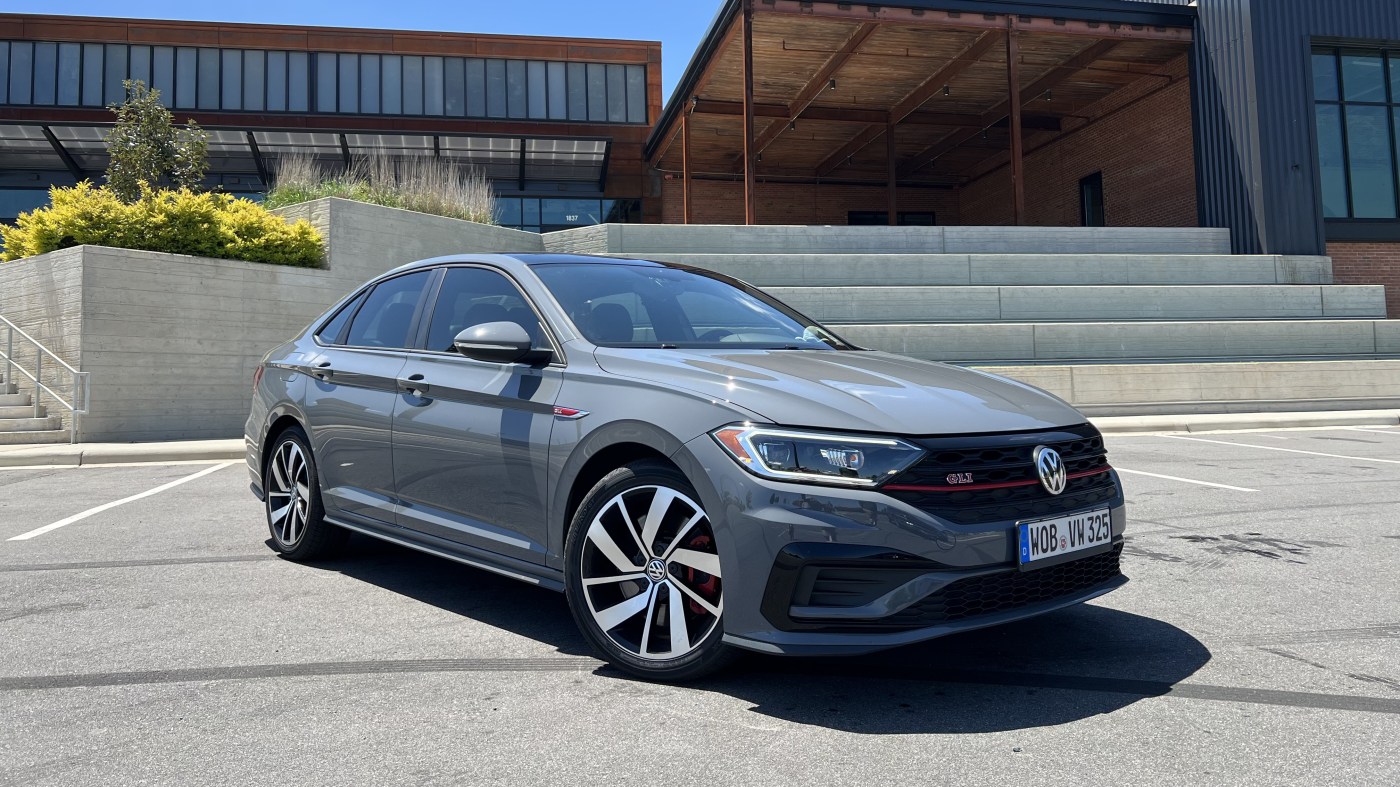
Following the massively successful launch of the Rabbit/Golf GTI in the mid-1970s, Volkswagen brought the performance treatment to the Jetta sedan in 1984, launching the GLI. Now in its seventh iteration, the Jetta is as good as ever, despite declining in popularity as market trends shift. Last year, I had the opportunity to spend a day with my good friend’s recently acquired 2019 GLI Autobahn model.
On the outside, the Mk7 GLI distinguishes itself from the regular Jetta with subtle black and red trim accents as well as other badging details. Behind the unique 18-inch alloy wheels are bigger brakes; the front brakes are actually shared with the sportier Golf R. Finished in an aptly named shade called Pure Grey, the GLI follows Volkswagen’s typical mantra of subtle performance cars. To quote fellow YouTube channel TheStraightPipes, it’s “an appropriate amount of looks for the speed.” Missing are the crazy exhaust tips or flamboyant spoilers of other sport compacts. In fact, around back, you really only notice the GLI badge, or the diffuser if you’re really paying attention.
I must admit, with the transition from the Golf hatchback to Jetta sedan, VW omitted one of my favorite quirks about the GTI – the trick rear emblem. On the GLI, it’s just a badge, whereas on the GTI and Golf R, it flips up to hide the backup camera, and it even functions as the trunk release.
One of the biggest criticisms I’ve heard about the seventh generation GLI is the interior being too boring or too cheap. Granted, there are a few areas that are not incredibly visually enticing, and there are plenty of less expensive plastic components, but it’s important to remember the compact sedan roots. A base Jetta starts around $20,000 in the US, and with that in mind, the interior feels fairly premium.
While a fully loaded GLI almost reaches $35,000, Volkswagen has added a handful of nice changes to bring the cabin upmarket in those models. Straight ahead of the driver is a highly customizable, full color digital gauge display (which you won’t find in any Mk7 GTI) and a leather wrapped steering wheel. The center stack features a moderate sized infotainment screen with Apple CarPlay, and physical controls for things that matter, such as volume and climate. The driver also enjoys a fully power seat that’s both heated and cooled, another feature the Mk7 GTI lacks.
Unfortunately, the Jetta lacks a ratcheting, height-adjustable center armrest, which much like the hidden backup camera, has been one of my favorite VW quirks. Weirdly, radar cruise control is also missing from the top-end Jetta and GLI for 2019, although you do have just about every other modern safety feature you’d expect.
Every variant of Jetta sedan has a longer wheelbase than the Golf hatchback, which translates to greater rear seat legroom and cargo space. At 14.1 cubic feet, the trunk is actually closer in size to a midsize Toyota Camry than to a Corolla. The stretched wheelbase also becomes a benefit on the road, slightly improving high-speed stability versus the shorter GTI.
The overall driving experience, in typical German fashion, is simultaneously excellent and overdone in some areas. The 228-horsepower 2.0-liter turbocharged four cylinder engine sounds decent and offers plenty of punch in stock form. It’s also incredibly easy to tune. However, the “Soundaktor” fake noise generator is very overbearing in sport mode. Unless you’re only going to drive in comfort mode, I would strongly recommend unplugging it under the hood or disabling it through coding.
The seven-speed DSG is incredibly smooth for a dual clutch, much smoother than the last GTI I drove. Disappointingly, in stock form there’s no way to take full manual control of shifting. Even using the paddles, the transmission will automatically upshift every single time – usually even before you hit redline. The good news is, a tune can fix that.
It shouldn’t come as a surprise to anyone that handling is one of the GLI’s strong points. That said, I can’t help but think wider tires would make it one of the best. From the factory, you’ll only find 225 section tires front and rear, which are narrower than both the Civic Si and Elantra N. In the last twelve months, my friend has added larger summer performance tires, which I’m told have made a noticeable improvement. The car rides well in terms of composure and body roll, but is way too harsh over even the smallest bumps.
Chances are, the GLI is probably going to be your daily driver. In that regard, it’s an excellent pick. Fuel economy is good, it’s easy to average around 40 mpg from the EA888 2.0T as I’ve proven in the GTI. It runs on 87-octane gasoline, which makes it easier on the wallet. The Hyundai Elantra N and Subaru WRX both require premium 91 or 93, and the turbocharged Mazda3 recommends premium to achieve its maximum power output. The seats are comfortable, and there’s plenty of technology. My only real complaint on a day-to-day basis would be the ride – and that’s coming from someone who likes firm suspension.
Overall, if I were in the market for a compact sport sedan, the GLI would continue to be my top pick. The all-wheel-drive turbo Mazda3 would be a strong second, as it offers a nicer interior but is less sharp to drive. Over the WRX or Civic Si, though, the GLI is a clear winner.
| Vehicle Tested | 2019 Volkswagen Jetta GLI Autobahn |
| Color | Pure Grey / Titan Black |
| Drivetrain | 2.0L turbocharged I4 / 7-speed DSG / Front wheel drive |
| HP / Torque | 228 horsepower / 258 ft-lbs |
| Curb Weight | 3,355 lbs (est.) |
| 0-60 mph | 5.8 – 6.2 seconds (est.) |
| EPA Fuel Econ | 25 city / 32 hwy / 28 combined |
| MSRP | $33,875 (est.) |
 Also Andrew