
A few weeks ago, I found myself with a brand new Ford Mustang Mach-E for the weekend. I had actually planned on taking it on a a road trip up to Washington, DC for the 2023 DC Auto Show. For some reason, December/January-time is when I tend to do road trips. In January 2020, I went to Orlando. Last year, I ended up going to Ohio three separate times in the span of a month and a half. Despite all these road trips, I’ve never done one with an electric car.
Unfortunately, things didn’t quite go to plan with this adventure, and I didn’t make it to DC. However, I did still live with the Mach-E for three days and put over 300 miles on it.
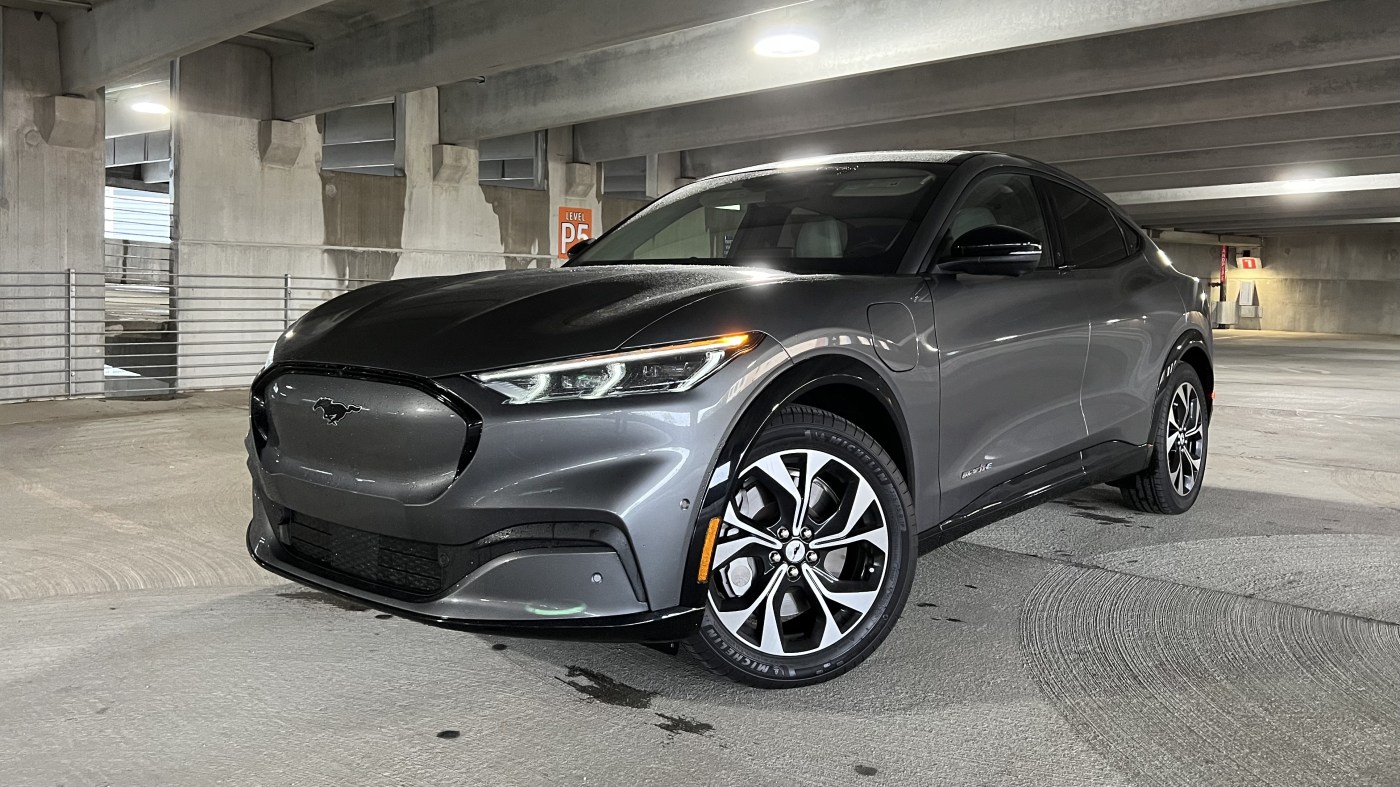
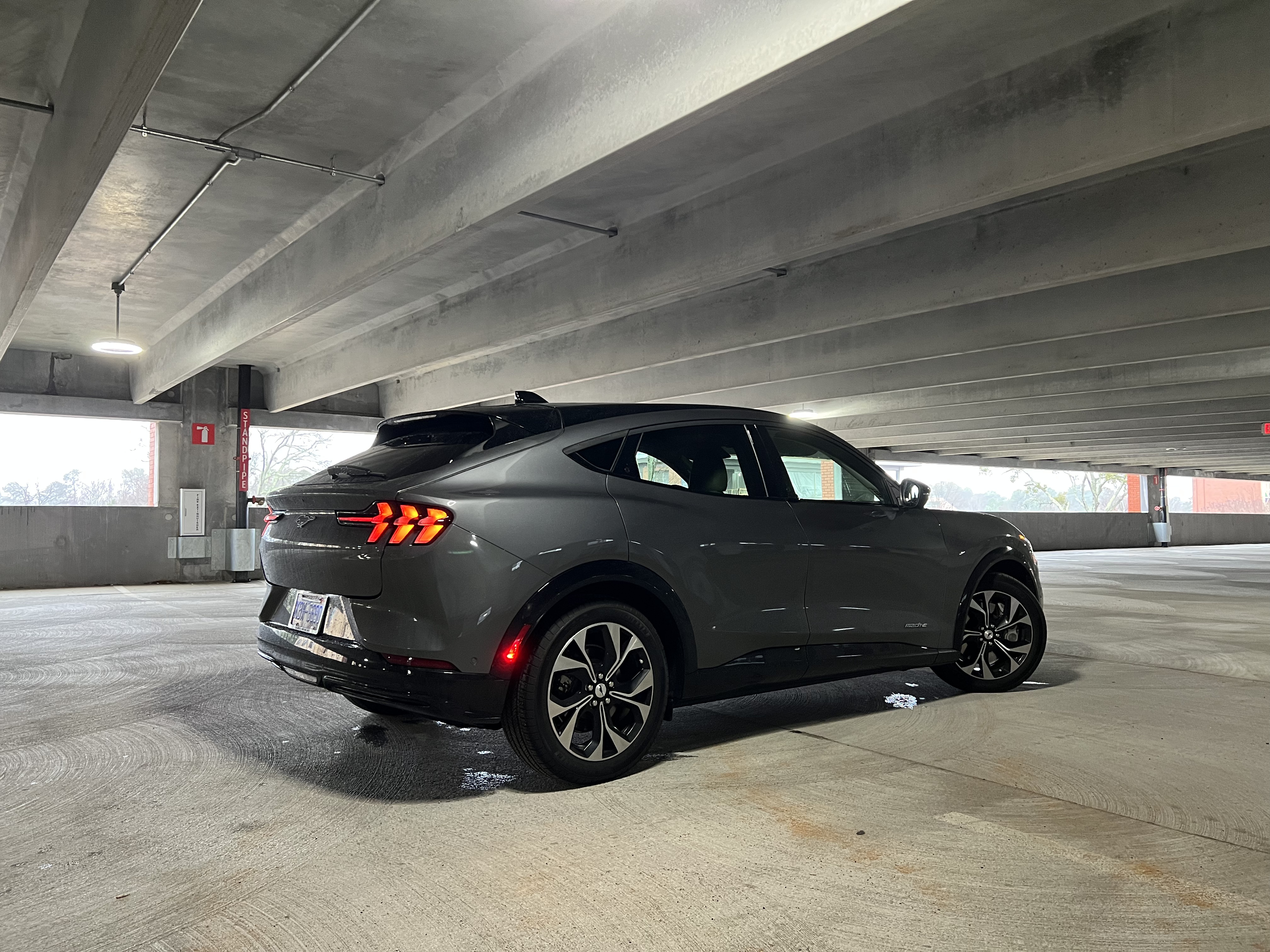
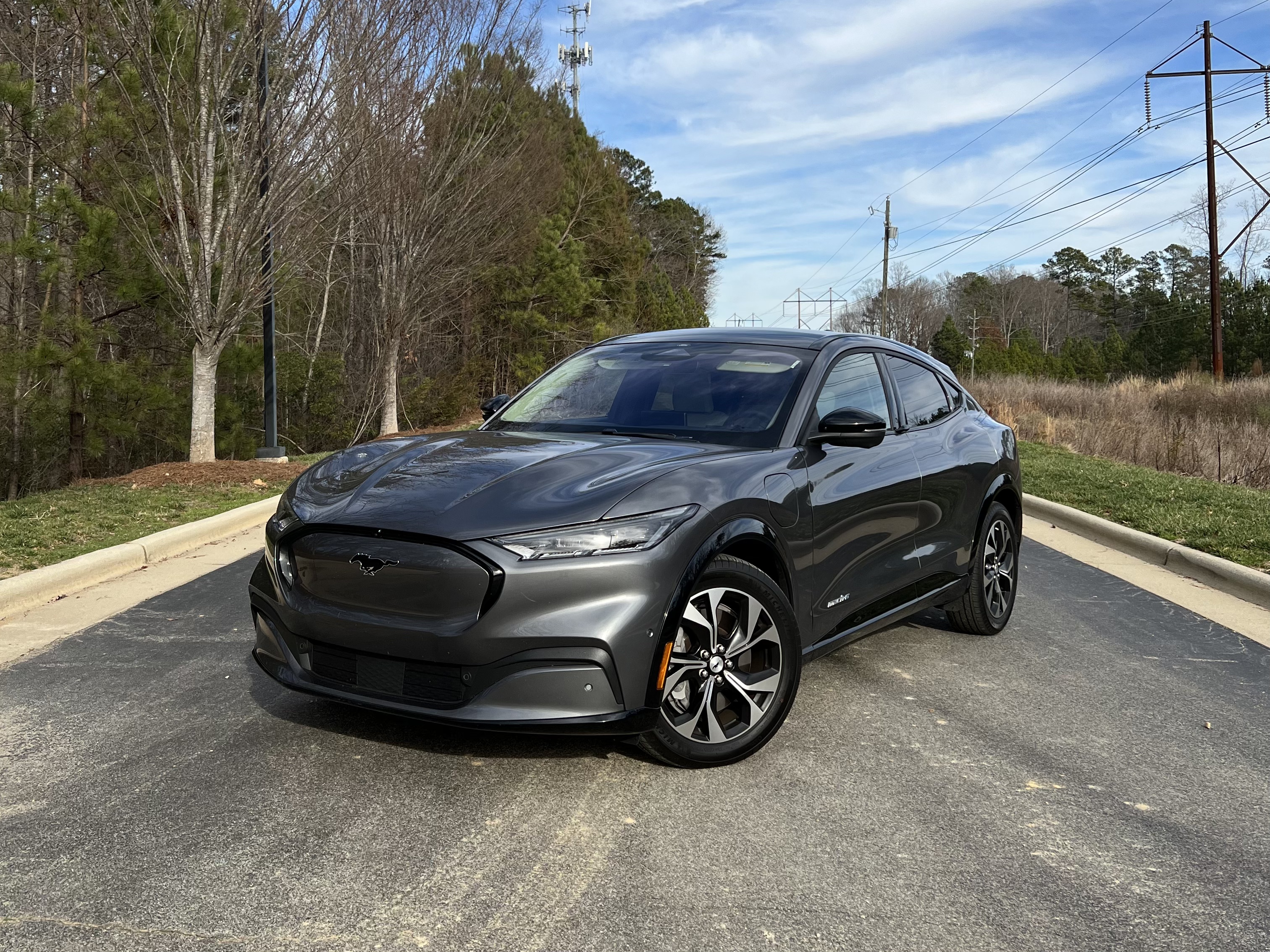
First, I have to talk about the fact that Ford decided to use the Mustang nameplate on this four-door electric crossover. They have given it some Mustang design cues, even though overall it looks absolutely nothing like a traditional Mustang. The fastback roof shape is present, even though they’ve just deployed a bit of visual trickery with the paint to get there. The tail lights are Mustang-esque, and of course they feature sequential turn signals.
To make it look more like a coupe, traditional door handles are gone in favor of electronic releases. The front doors have a button and a small lip for you to pull. The back doors, on the other hand, don’t have a place for you to grab, so I guess you’re just supposed to grab the paintwork? That doesn’t seem like it will hold up long term. This style of door entry does also help aerodynamics, which is very important for efficiency in an EV, and it’s better than Tesla’s hidden handles, but it’s still not the best solution.
Additionally, there aren’t any Ford badges anywhere on the Mach-E. The front end, back end, wheels, steering wheel, and kickplates all feature Mustang logos. They don’t want you to know it’s a Ford, or even emphasize it’s an electric Mach-E, but they certainly want you to know it’s a Mustang! Take from that what you will.
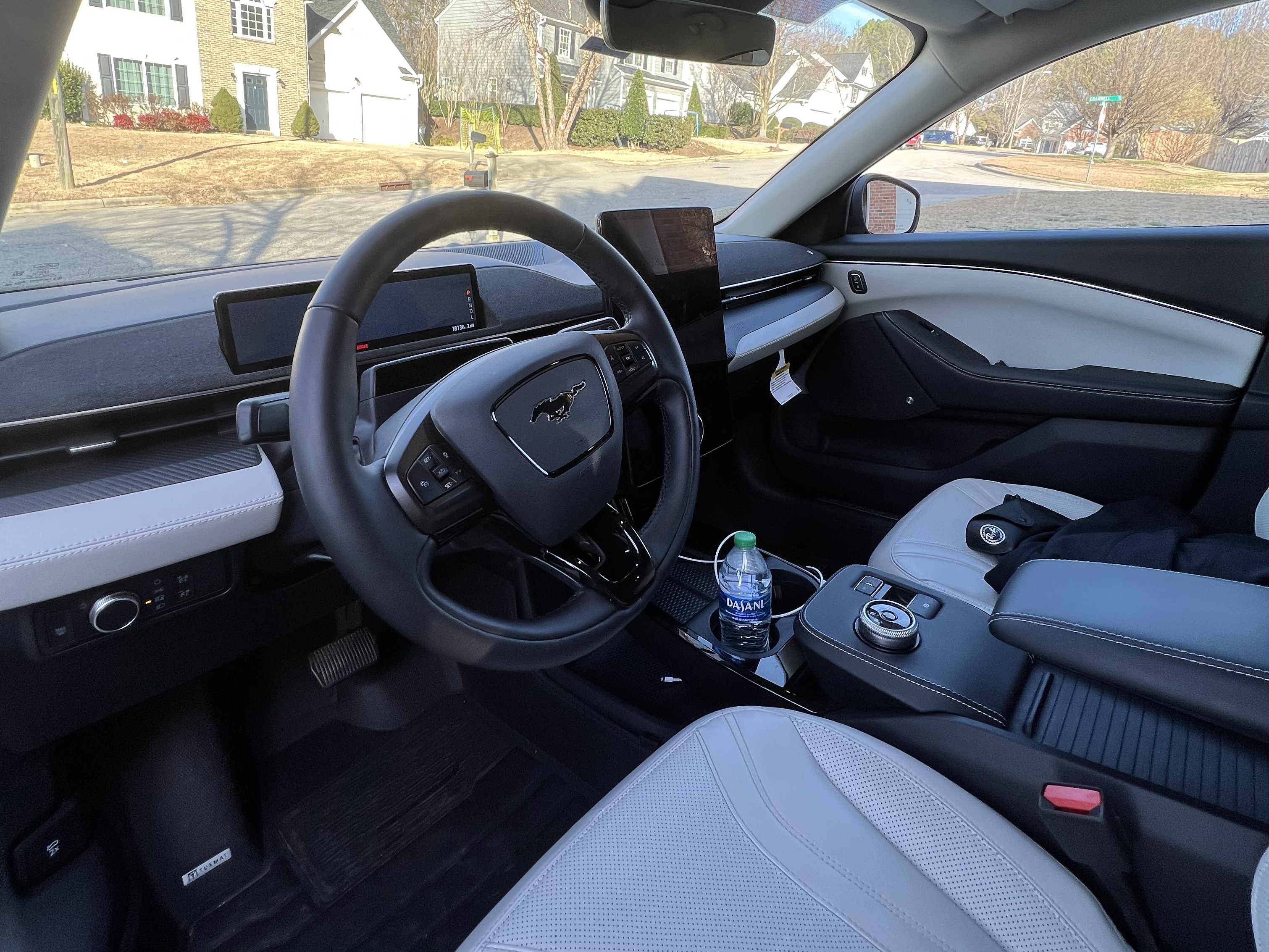
The interior space is by far the best part of the Mach-E. It’s miles ahead of a Tesla, but then again, so is a hospital waiting room. The entire interior is visually attractive (admittedly the two-tone of this example does contribute significantly) and everything feels well put together. The seats are initially very comfortable, despite lacking tilt adjustment. Although, once you’re in them for longer than an hour or two, the thigh area starts to be a tad unsupportive.
My favorite thing about the inside of the Mach-E has to be the dashboard. Again, the design is visually attractive, and the material choices are excellent with a combination of imitation leather, fabric, and carbon fiber texture. The gauge cluster display in front of the driver, despite not being customizable, gets a pass for being simple and easy to understand.
The 15-inch infotainment screen is obviously the focal point, though, and that’s where the quality starts to drop off. The screen itself is perfectly fine; it’s a good size without being overkill, and the panel is nice to look at. However, there’s entirely too much going on with the interface.
The volume dial being integrated into the panel is a cool design touch, and I appreciate that it’s still a physical control. The climate controls, on the other hand, are not physical. Every time you adjust the temperature, fan speed, or one of the heated seats, a slider pops up, and it does not go away on its own. Therefore, Ford has added an additional unnecessary button tap that requires your eyes to be off the road for even longer, for functions that most people are very frequently using. And God forbid you want to change a setting while you’re driving, because there’s about six million menus, and most of them aren’t locked out while the vehicle is moving. Even after 300 miles of seat time, I still found myself confused and hesitating looking for certain settings or features.
Rear seat and cargo space are both positive. Once you get past the electronic door buttons, the backseat of the Mach-E is not a bad place to spend time. The materials are consistent with the front, and the all-glass roof makes it feel bigger than it is. As with most electric cars, there’s no transmission tunnel, so legroom is unconstricted. The fake fastback roof shape also becomes a huge plus — headroom is plentiful since the roof doesn’t actually slope very much.
Behind the power liftgate, you’ll find 29.7 cubic feet of cargo space with the rear seats up, and 59.7 cubic feet with the seats folded down. These figures are virtually identical to the Tesla Model Y, Volkswagen ID.4, and Hyundai Ioniq 5. However, it is worth noting that all four of these vehicles are slightly smaller than the gas-powered alternatives in this size class.
It goes without saying that the Mach-E is not going to drive similarly to a traditional Mustang either. Obviously, there’s no V8 exhaust note and there’s no banging through gears. However, The Mach-E’s driving experience, while very different, is actually another major highlight.
When the Mach-E first went on sale two years ago, I remember seeing internet critics like myself complaining about the ride being too soft or bouncy. This was mainly on forums, and you always have to ask, “What did you drive before the Mach-E?” Almost every time, the answer was “a Performance Package Mustang GT” or “a Shelby”. Of course the Mach-E is going to be soft compared to those vehicles. It’s also significantly softer than my Audi S4, but that’s not a bad thing. It handles poor roads well, but it’s not too soft to the point of ruining cornering ability. As with most EVs, the low center of gravity also contributes significantly to handling. The biggest weakness of the Mach-E’s handling, in my opinion, is the tires. Replacing the 225 width tires, while they are more efficient, would significantly improve performance.
I also recall hearing complaints about the brakes, specifically the pedal feel and regen. I do agree the brake pedal is overly sensitive on the top end, and the calibration of the blended braking system produces a double stopping effect that feels rather odd. After 300 miles, I still found it difficult to produce smooth low-speed stops out of the Mach-E. I did manage to get the hang of one-pedal driving, however, and the adjustability of this feature is nice for those that may not be familiar with electric cars.
In Premium trim, the Mach-E is also very well equipped, with a 360-degree camera, B&O sound system, and full LED lights. A few comfort features are missing, such as ventilated/cooled seats, but the heated seats and steering wheel almost work too well. You have all the modern safety tech that would be expected on a car of this price point, including BlueCruise, Ford’s hands-free highway driving assistant. Basic lane centering is also present, for roads where BlueCruise is unavailable. They both have a tendency to get confused when lanes are added or removed from the road (i.e. when a turn lane or exit lane begins or ends), but overall both systems work well.
During my weekend with the Mach-E, I charged it primarily on the Electrify America network. While EA consistently ranks low for charger reliability, their Pass+ membership plan buys down your charging cost significantly, and pays for itself after just one charging session. I also plugged the car into a wall outlet in my garage, but was only able to achieve 20-30 percent charge overnight this way. Installation of a 240V outlet at home will be a necessity for most folks, if they don’t want to rely on public charging or have a charging solution at their place of work. The good news is this added cost is a one-time expense and not vehicle-specific, unless you install a proprietary Tesla home charger.
For those that plan to drive their Mach-E longer distances on a regular basis, the biggest pain point won’t be cost, but rather the charging curve. The Mach-E that I experienced was the base single motor variant with the smaller battery option. Real world range of 225 miles and peak charging speeds of 150kW are perfectly acceptable, but the way the car is programmed to accept different levels of power is not ideal.
The Mach-E is only programmed to accept 150kW for a short period of time after you plug in. By the time you get to 50 percent state of charge, you can expect to see speeds in the 70-80kW range. Once you hit 80 percent, the speed is cut in half yet again. All EVs charge slower on the top portion of the battery, but an Audi E-Tron can accept peak speed all the way to 80 percent. The Hyundai Ioniq 5 charges significantly faster overall (under the right external conditions) thanks to its 800V architecture.
Built in route planning is another key part of road-tripping an EV. The Mach-E’s navigation system does a great job of selecting the most efficient charging route, although it’s not adaptive. Once you begin the route, it does not automatically add or remove charging stops, or re-route you if external conditions cause your driving range to vary. I also couldn’t find a way to select a network preference, but that may have been due to the aforementioned interface complexity.
I must admit, I really enjoyed my time with the Mach-E. Even though it’s not a traditional Mustang, it’s a comfortable daily driver with an excellent interior, and the driving experience is better than you would expect from a rival gas-powered crossover such as a Toyota RAV4. If you find yourself taking longer road trips frequently, however, you might want to consider one of the alternatives.
| Vehicle Tested | 2021 Ford Mustang Mach-E Premium Standard Range RWD |
| Color | Carbonized Grey Metallic / Light Space Grey ActiveX |
| Drivetrain | Single electric motor, rear wheel drive |
| HP / Torque | 266 horsepower / 317 ft-lbs |
| Curb Weight | 4,318 lbs (est.) |
| 0-60 mph | 5.8 seconds (manufacturer est.) |
| Range | 240 miles (EPA) |
| MSRP | $50,995 (est.) |
 Also Andrew