

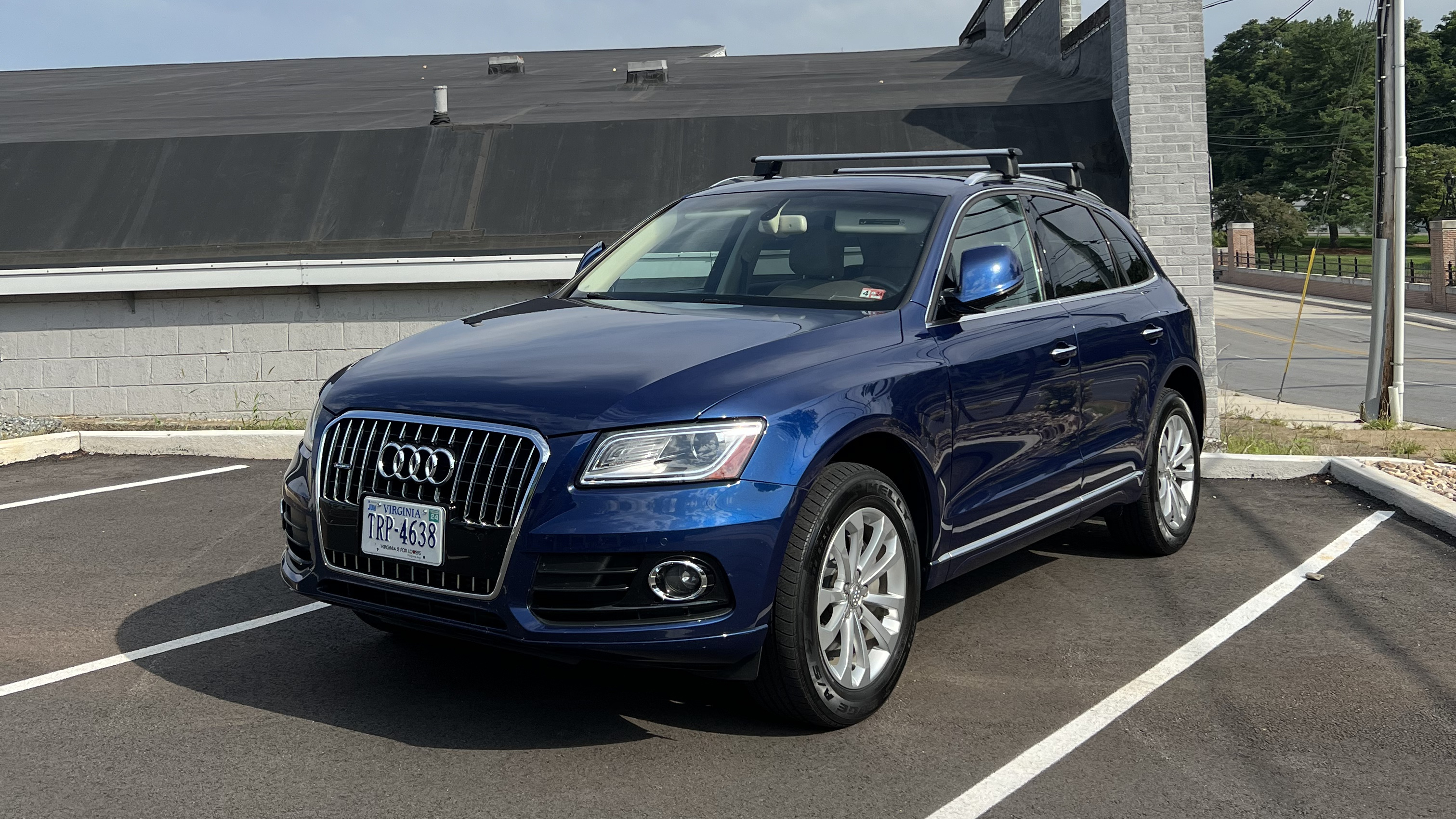
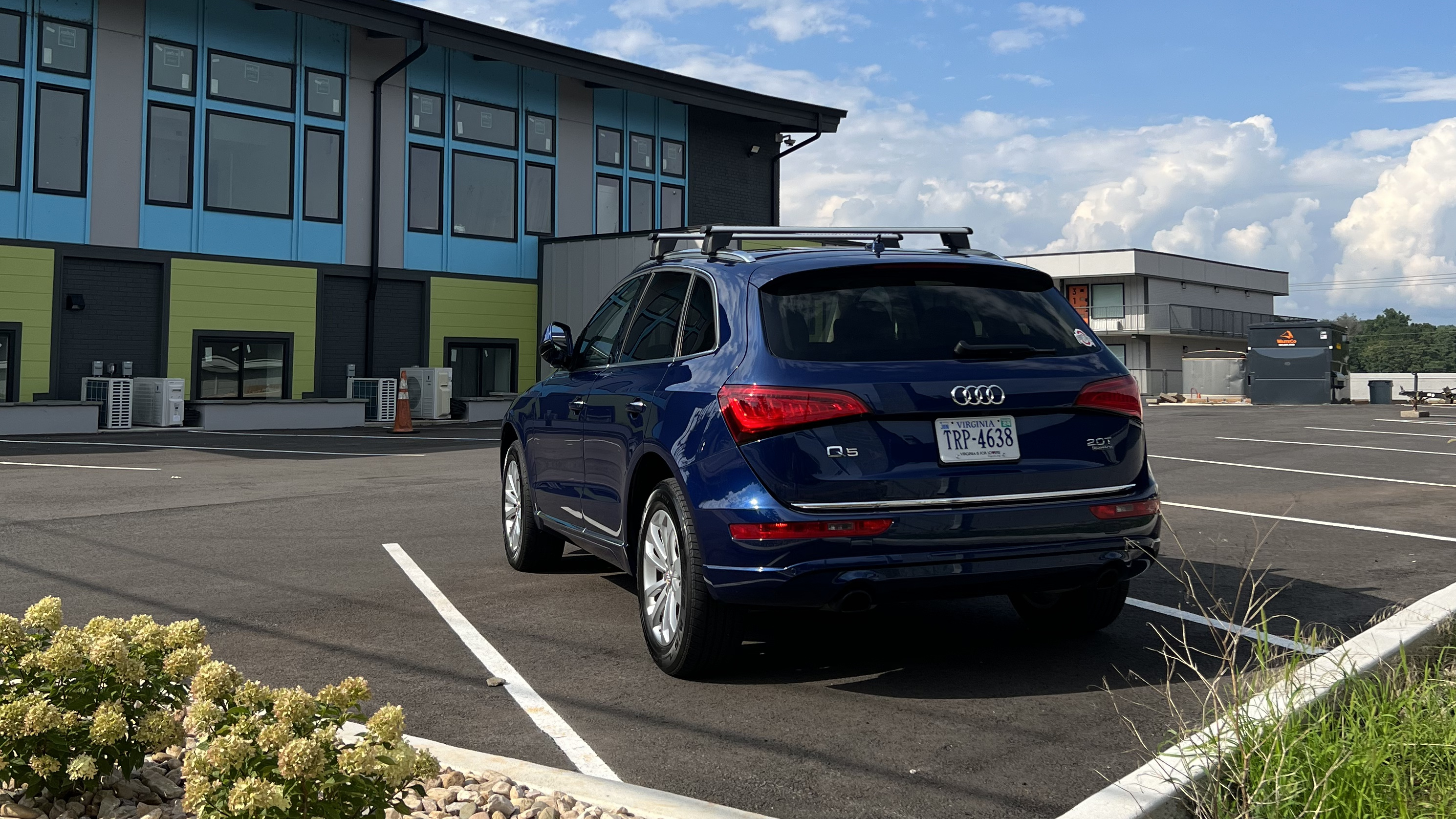


The first car I ever reviewed on my YouTube channel back at the beginning of 2021 was my first blue Volkswagen, a Mk7 Golf Alltrack. 2.5 years and 7 cars later, I find myself back in a blue VW, this time a B8.5 Audi Q5. After selling my BMW i3 to Carvana a couple months ago, I added this Scuba Blue 2016 Q5 to the garage.
The facelift B8.5 generation of Audi’s small SUV ran from 2013 to 2017 in the US. With the facelift, Audi made minor visual and tech changes, and ditched the old 3.2-liter V6 in favor of three different engine options. Premium and Premium Plus trim levels came standard with a 2.0-liter turbocharged four-cylinder; Premium Plus and Prestige versions were available with either a 3.0-liter supercharged gas V6 or a 3.0-liter turbodiesel V6. I was initially interested in purchasing a TDI Q5, as they’re the fastest when tuned and the most rare.
But that’s the problem – they’re the most rare. Audi didn’t build a ton of them to begin with, and after Volkswagen’s Dieselgate scandal, they’ve become way more desirable since it’s highly unlikely we’ll ever get a new diesel VW or Audi in the US again. I ended up finding a very nicely specced 2.0T Premium Plus Tech Package example in Carmax’s network, and had it transferred to my local store to test drive and buy after realizing it ticked almost all my other boxes.
In stock form, the 2.0-liter turbo (as seen in many other VW Group products), produces 220 horsepower and 258 lb-ft of torque. Like the TDI V6, it’s easily tunable, though I honestly have no desire to tune the Q5 like I’ve done to my S4 and other cars. From my experience with the 2.0T in other cars, it’s refined, decent on gas, and for the most part reliable if taken care of. It enables a reasonable mid-six second 0-60mph time, which is perfectly adequate for most driving. My only gripe is that in contrast to the GTI and other models, you can’t run it on regular 87-octane fuel.
Inside, you’ll find 29.1 cubic feet of cargo space with the rear seats up, and 57.3 cubic feet with the seats folded down. Speaking of, the rear seatbacks can be folded from either handles on the side of the seat base, or from side the cargo area, which is super convenient.
As a passenger, you can use the same handle to choose one of two recline positions. Overall, rear seat space is above average for the segment but larger options like the Volvo XC60 are available. The transmission/driveshaft tunnel is rather pronounced so the middle seat is really best for children, but outboard passengers have a good amount of space. Interestingly, it’s worth noting the newer B9 generation Q5 (2018 and up) is slightly larger in the cargo area and significantly smaller in the back seat.
Hopping out of the rear and into the front, you’ll notice keyless entry touch sensitivity on all four doors, which is something I’ve been spoiled by on my B9 S4 for the last year. Speaking of the key, it’s the same basic key design that was used on the Lamborghini Aventador and Huracan until just recently.
In my opinion, the Pistachio Beige and chocolate brown two-tone interior has aged decently for a design that’s now over 10 years old. All of the materials are still premium, the front seats are super comfortable, and it still feels fairly new. Technology wise, however, I can’t say the same. The infotainment screen is small by modern standards, and lacks Apple CarPlay despite being available on other VW models of the same year. I appreciate the simplicity of the analogue gauges, but color display centered between them is slow and highly confusing to use. Also, there’s no track buttons on the steering wheel!
Being a Premium Plus equipped with the Technology Package, my Q5 features niceties like seat memory, heated power folding mirrors, blind spot monitoring, parking sensors, and the upgraded Bang and Olufsen sound system. It also has a backup camera which works about 75 percent of the time. (That will become my first warranty claim to Carmax soon enough.) When it is working, it’s pretty low resolution and the colors are not great, which is to be expected for being an older camera system. Also annoying is the lack of a sync setting for the dual-zone climate control.
My favorite quirk of the Q5’s interior by far is the hole in the dashboard meant for inserting the key fob. Pre-facelift models did not feature push-button start, but Audi didn’t remove the hole when the feature was added. It still starts the engine if you use it, even though there’s no reason to do so normally anymore, but it’s nice to know there’s a backup method if you need it.
Out on the road, the Q5 is supremely comfortable compared to my S4, with a smooth and well balanced ride. That’s not to say my S4 rides poorly — the adaptive dampers in that car are excellent — but the Q5 is always going to be softer and more compliant. There is absolutely nothing that makes the Q5 exciting, but it makes for a pleasant daily driver, which is why I chose to purchase it in the first place.
I plan to sell my S4 in the near future, and potentially buy a dedicated sports car towards the end of the year. In the meantime, though, I look forward to many miles to come in this new-to-me Q5. Will I miss having a V6 and regret not holding out for a TDI? Time will tell.
| Vehicle Tested | 2016 Audi Q5 Premium Plus w/ Tech Pkg |
| Color | Scuba Blue Metallic / Pistachio Beige & Brown |
| Drivetrain | 2.0L turbocharged I-4, 8-spd automatic, All wheel drive |
| HP / Torque | 220 horsepower / 258 lb-ft |
| Curb Weight | 4,200 lbs (est.) |
| 0-60 mph | 6.5 seconds (est.) |
| EPA Fuel Econ | 20 city / 27 hwy / 22 combined |
| MSRP | $48,740 |
 Also Andrew