
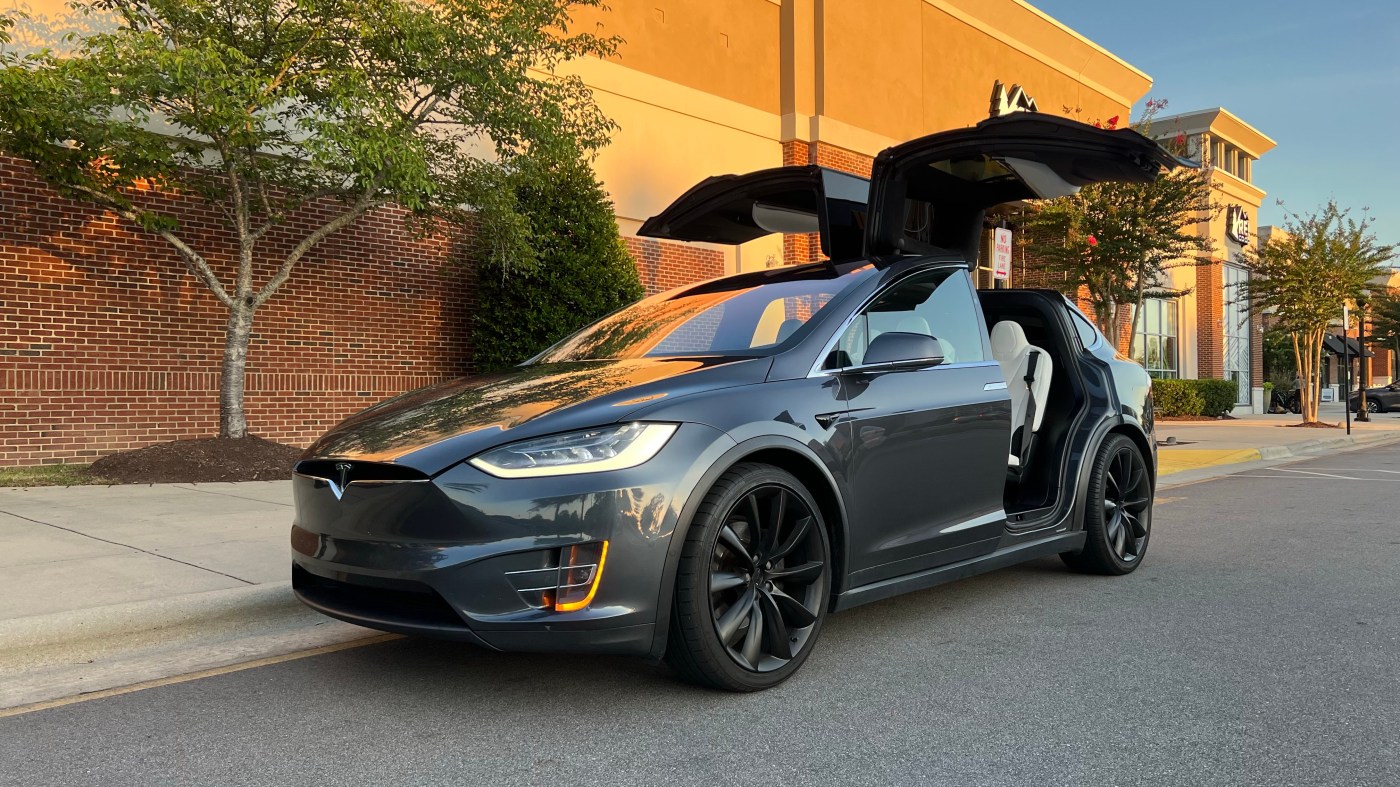
First unveiled in 2015, the Tesla Model X is recognized as the first truly mass-produced BEV SUV, and if nothing else certainly made a huge statement. As an alternative to a traditional 7-seat luxury hauler like an Audi Q7 or Mercedes GL, you could now spend six figures on a futuristic, all-electric alternative with rear doors that go up.
Tesla calls them “falcon wing doors” and insists the Model X is a crossover, but reviewer Doug DeMuro infamously referred to it as the “pigeon-winged minivan.” It has now been eight years since the Model X’s initial launch, so I decided to rent a 2017 Model X 100D to put a few hundred miles on and see how it’s held up.
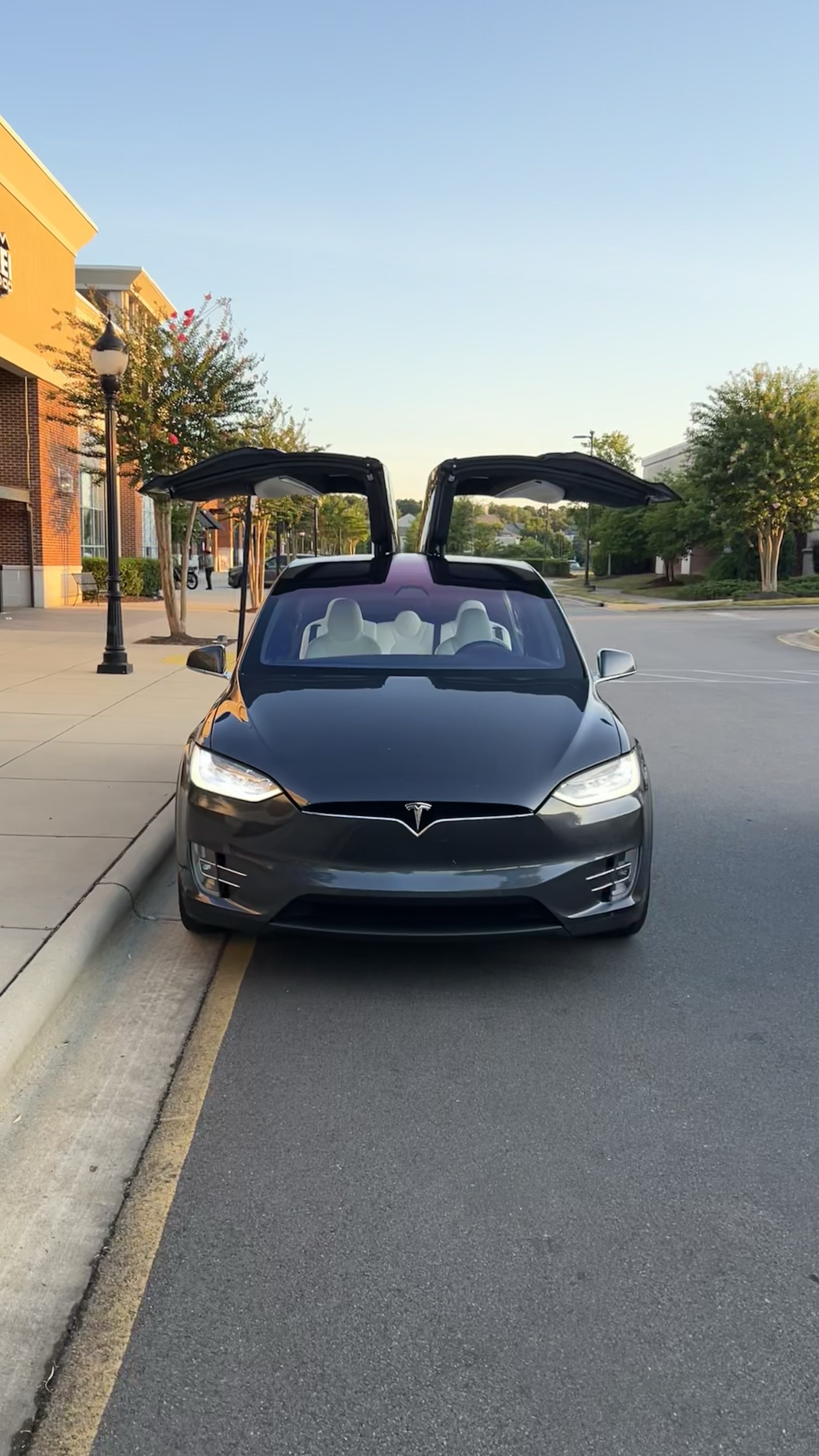


I suppose it’s unavoidable for the doors to be the first point of discussion. There’s no denying they’re cool, and even after the Model X has been on the road for so long, they’re still attention-getting. True story: I was having lunch with my grandpa a few weeks ago and saw a Model X owner using the doors, causing my grandpa to genuinely stop mid-sentence and ask what the heck it was.
Early production issues led to alignment problems, sensor malfunctions, and occasional complete failures of the doors. While Tesla has addressed some of these issues with software updates and mechanical tweaks over time, the reliability of the falcon wings remains a topic of concern. As it turns out, the doors and their push-button handles are also prone to act up when the cars get older (who would’ve thought?), and ultimately the practicality of them is still more a gimmick than a real benefit.
With this one specifically, the rear doors are insanely creaky when they’re moving. Unlike newer Xes, the driver’s door automatically opens when you approach the vehicle, and closes when you hop in and push the brake pedal. It’s honestly really cool to be able to get in the car without touching the door at all, and does mean that, yes, the door closes every time you touch the brake, which is kinda funny. In fact, all four doors can be opened or closed from the infotainment screen. You know what else has the ability to control the back doors from up front? A minivan.
As for the rest of the exterior, the Model X was also one of the first big SUVs to adopt the sloping, “fastback” shape. When it rolled onstage painted in white at the initial launch, it looked decidedly like a giant egg with wheels. In fairness, I think it looks rather sleek in grey, and it’s no longer the most egg-y EV on sale thanks to the Mercedes EQE and EQS. The 22-inch turbine wheels are also still some of my favorites in the industry.
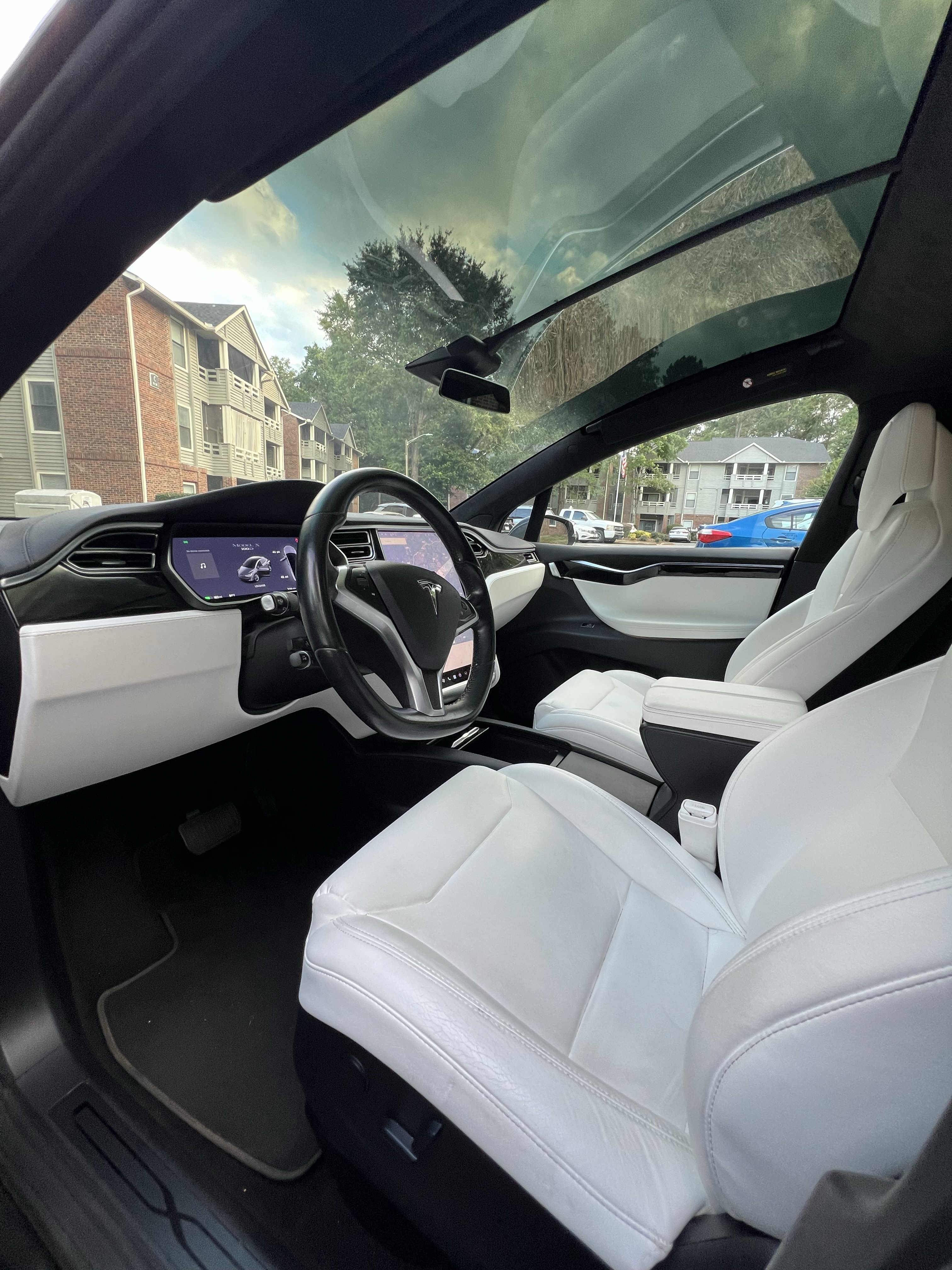
Hopping behind the wheel of the Model X, the pigeon-winged minivan’s other standout design choice immediately presents itself. Since this is an earlier X, I’m not talking about the yoke steering wheel that now comes as standard. Unless the sun visors are in the way, you have an uninterrupted sheet of glass all the way from the dashboard to behind your head. Aside from the Lucid Air, it’s the largest single piece of glass fitted to any new production vehicle. The rear doors also have their own little sunroof panels, further enhancing the greenhouse effect and the brightness of the white interior.
The front seats are incredibly comfortable, and I must say I’m thankful for all of the adjustments (steering wheel, mirrors, etc.) being physical rather than done through the infotainment screen. In my opinion, the interior design has aged fairly well considering the original Model S came out 12 years ago. The materials and build quality, on the other hand, really haven’t. The Model X 100D was near enough a $100,000 car when new, and on the current used market is a $30-35,000 car. It definitely feels every bit of a $30,000 interior; I couldn’t imagine paying three times as much for it.
The decade-old Mercedes switchgear still feels alright, but certainly dates itself. The dashboard panels squeak, and the driver’s door panel rattles way more than I would prefer. The driver’s seat also squeaks when you slide in and out, though the white upholstery has held up incredibly well all things considered.
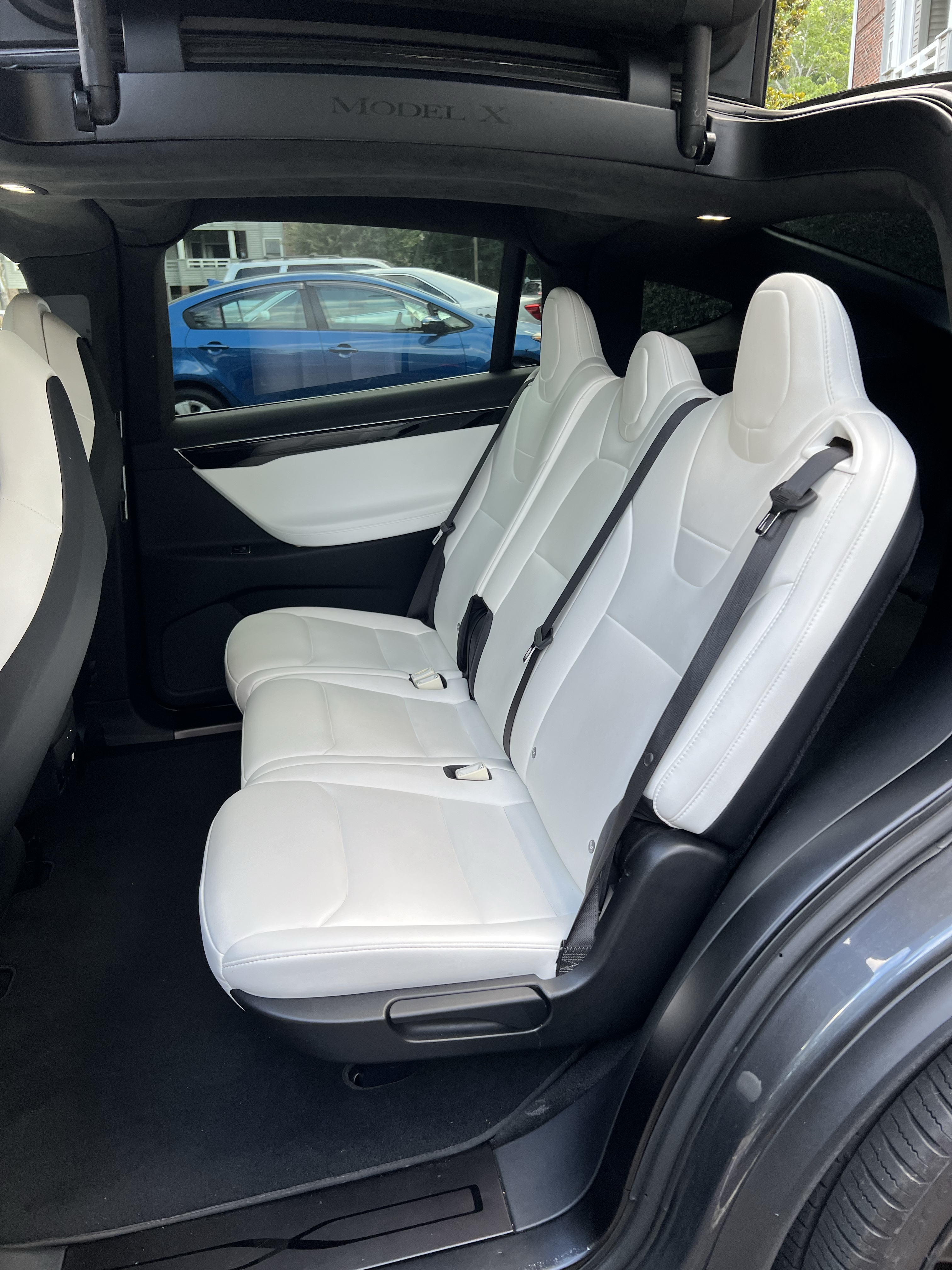
The rear bench seat is more sculpted into three buckets than most other SUVs, and is just as comfortable as the front. Opting for the X’s six- or seven-seat configuration adds power adjustments to the middle row. Inexplicably, even in the five-seat configuration, the rear seats don’t fully fold down, which is a huge impairment to cargo practicality. I also wouldn’t recommend storing much of anything in the front trunk, as there’s an easily accessible release under the front bumper. It sets the alarm off of course, but by the time you get out to the car a thief could’ve closed the frunk, run away, and you wouldn’t be any the wiser.
Arguably the best thing about the Model S and X interior, which fortunately they’ve still maintained to this day, is the presence of a traditional gauge cluster screen. Well, when I say gauge cluster, I really mean “information panel” because there aren’t any remnants of actual gauges to be found. Speed, battery charge, and other info are all digital, and in typical Tesla fashion the display doesn’t offer any substantial customization. Still, there’s something to be said for having your speed and Autopilot details displayed right in front of you rather than out of your regular line of sight.
Speaking of Autopilot, I’ve always viewed Tesla’s driver assistance/self-driving tech pretty favorably, aside from not being a fan of some of their feature mislabeling and questionable marketing. That said, most of my seat time has been in newer models where they use touch sensors in the steering wheel and cabin cameras for attention monitoring, rather than the weight/steering wheel movement-based system in this 2017 Model X, and it is definitely far more sensitive than I was expecting.
This is especially important with the addition of a recent software update that puts additional restrictions on Autopilot if it thinks you’re misusing it. If you have “Joe Mode” enabled, where the car’s beeps and chimes are significantly reduced, it’s way too easy to miss Autopilot’s “apply steering force” warnings until the very last second. In this case, you’ll lose access to the steering assist functionality for the remainder of your current trip, or at least until you cycle the car through park and back into drive. Until recently, there was no real consequence for doing this; you could easily reactivate it as many times as you wanted.
Now, however, if you get to three forced deactivations, you lose access to Autosteer for an entire week. This happened on my very first day with the car, all because the warnings were too subtle and the car didn’t realize I indeed had my hand on the wheel because I was letting it do the steering work for me (i.e. the point of the system in the first place). I tried everything to get it back; switching driver profiles, creating new profiles, even hard-resetting the infotainment system, to no avail. Luckily, an overnight software update reversed my ban on the second night and I’ve now learned to just be way more careful with it.
As for the rest of the Model X’s driving experience, it’s a bit of a mixed bag. Unlike the smaller Model Y and 3, the S and X feature adjustable air suspension. While the GPS-based memory is a cool feature, I wish it did more for the ride quality. The last two vehicles I’ve driven with air suspension are an Audi e-tron and a Jeep Grand Cherokee Overland, and I was expecting the Model X to be closer to the Audi than the Jeep. I was wrong. I suppose it’s not helped by the 22-inch wheels, but the X honestly doesn’t ride drastically different to the last base Model 3 I was in. We’ve all seen old Range Rovers and Mercedes with failed, sagging air suspension… it’s only a matter of time until the X joins the club.
The Model X 100D is also plenty quick, even though it’s not the top-end P100D with the “Ludicrous” mode. A 4.5-second 0-60 time is honestly all most people need, especially in a vehicle that tips the scales at over 5,200 pounds. It blows me away how many unsuspecting mother-in-laws are riding around in Plaids just because “it’s the fully-loaded model.” At least it’s still one of the highest-rated SUVs on the road for safety.
The X’s relatively low center of gravity leads to genuinely decent cornering ability, but there’s no way to truly hide the heft. Of course, there’s very little steering feedback or overall emotion from the X on a back road, but that’s to be expected.
Cruising the highways, though, the Model X is far more at home. As mentioned before, the seats are superb and the experience is overall quiet and calming, provided you can keep Autosteer in check. The audio system is decent, although the “Immersive Sound” mode makes it sound very hollow. It does have a real subwoofer, but it’s not overwhelmingly powerful.
Supercharging is a breeze as always. The opening of the Supercharger network to other EV drivers is a huge win; I’ve always said it was far superior to any of the other companies. So far, I haven’t seen it to be too much of an impedance to Tesla drivers either, as Tesla’s installations tend to be far larger (more charging stalls) than Electrify America and others. In 2017, the Model X 100D had an EPA-rated range of 295 miles, and in my real-world testing I’ve reasonably gotten between 200 and 225 from a full charge, which sounds about right considering it’s 7 years old and Tesla’s range estimates are usually inflated to begin with.
Overall, I enjoyed my road-trip time in the Model X. In many ways, it’s still more of a statement than anything else, and unless you need three rows of seats, the Model Y is objectively a better choice. That said, the Model Y doesn’t have doors that make it look like a fat pigeon trying to take flight in Times Square, for whatever that’s worth.
| Vehicle Tested | 2017 Tesla Model X 100D |
|---|---|
| Color | Midnight Silver Metallic / Ultra White Leather |
| Drivetrain | Dual electric motors, 1-spd direct drive, All wheel drive |
| HP / Torque | 577 horsepower / 508 lb-ft |
| Curb Weight | 5,267 lbs |
| 0-60 mph | 4.5 seconds (est.) |
| EPA Range | 295 miles |
| MSRP | $97,200 (est.) |
 Also Andrew
Leave a comment