
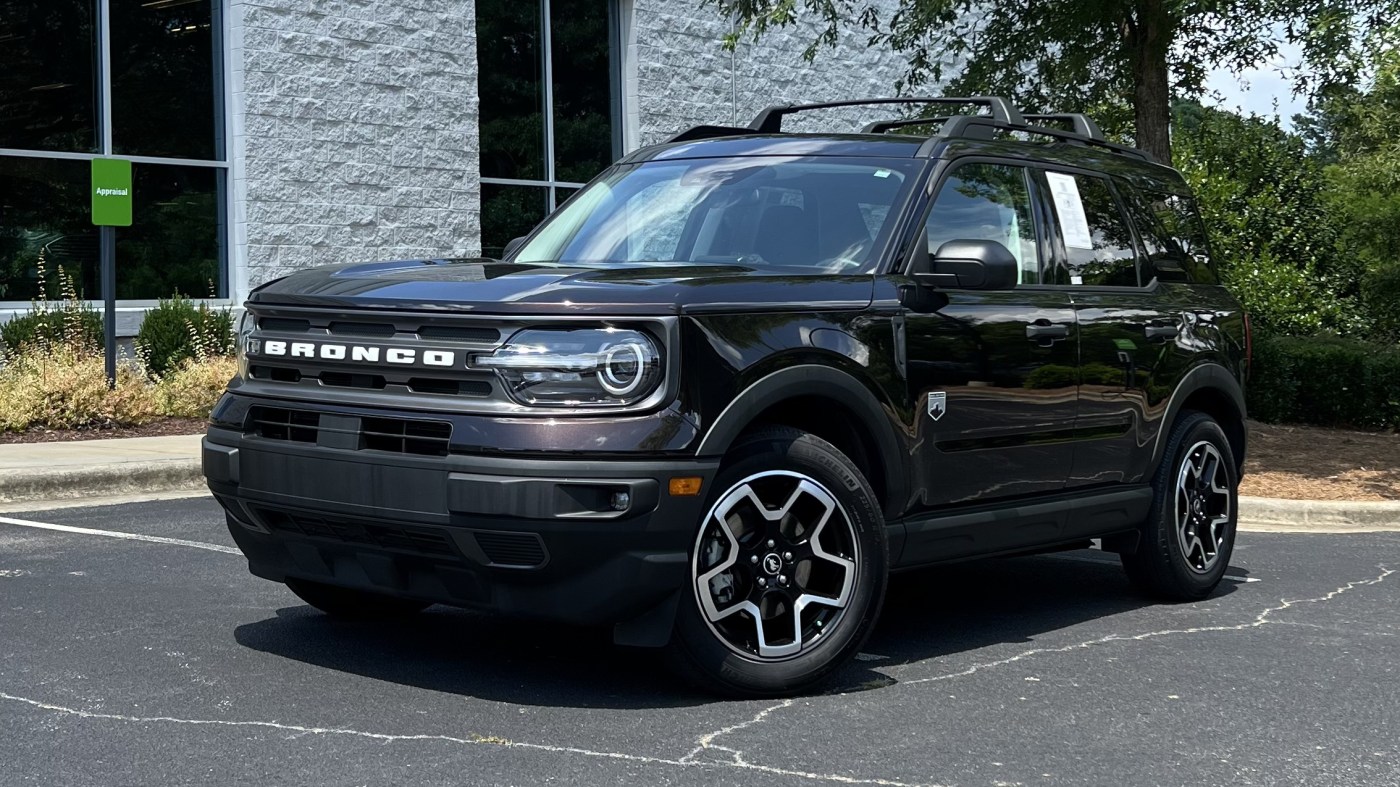
A few years ago, Ford announced the return of the famed (or infamous) Bronco as a direct rival to the ever-popular Jeep Wrangler. In an interesting twist, they also announced the Bronco Sport; a smaller SUV based on the Escape platform, but with four wheel drive and the boxy, rugged style of its big brother.
To the casual observer, a quick glance at the exterior would have most saying, “Hey, there’s the new Bronco!” But a second look usually ends with, “Wait, that’s the new Bronco?” That’s certainly what Ford wants you to think, because the largest badges front and rear both say “BRONCO” with “Sport” in letters a third of the size just below. In fact, the front end doesn’t even bear a Ford emblem, much like the Mustang Mach-E which puts a heavier emphasis on the “Mustang” part of the name than anything else.
Compared to the Escape on which it’s based, the Sport is actually slightly taller but about eight inches shorter. Many of the Bronco’s signature design cues are still present, including the round headlights, squared-off lines, and upright windows. There’s even a Heritage design package available which brings white accents to the grille, wheels, and roof. Unlike the big Bronco, however, the doors and roof are not designed to be easily removable.
Aside from looking cool, the boxy shape and short overhangs are also advantageous off road, where I’ve seen the Bronco Sport perform surprisingly well. Ground clearance sits at 8.8 inches, a nice medium between the Escape and full-size Bronco. The top-end Badlands trim also gets even slightly more of a lift thanks to bigger all-terrain tires. While you can’t necessarily go rock crawling with the Sport, it’s plenty capable of traversing trails.
On that point, the last Bronco of the 1990s featured a choice of giant V8 engines under the hood for a sense of power and prowess. Naturally, you’d imagine today’s Bronco to have downsized a bit, and you’d be right: the top-end Bronco is available with a 2.7-liter turbocharged V6. To step down to the base Sport, on the other hand, cut that number essentially in half: that’s right, it’s a 1.5-liter 3-cylinder. Personally, I’d step up to the optional 2.0-liter turbo-four which cuts over a second off the 0-60 time, but while the 1.5T’s 181 horsepower and 190 lb-ft of torque aren’t going to do any Baja running, it is honestly perfectly adequate.
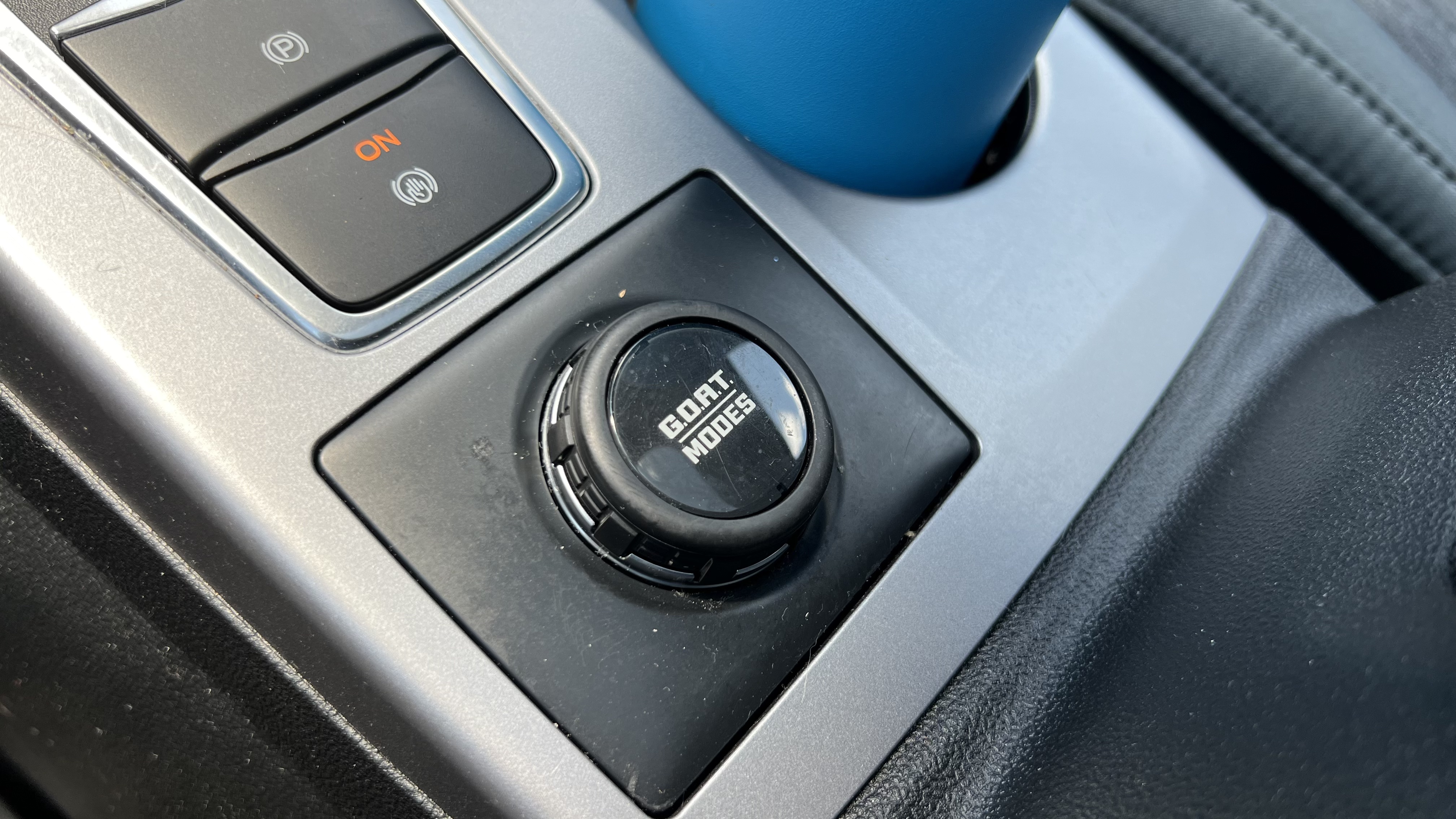
Regardless of engine, all Sports feature a full-time four-wheel-drive system with “GOAT” (Goes Over Any Terrain) modes, which is one of the other main differentiators versus the Escape, and the higher trims even feature a twin-clutch rear axle which functions similarly to a differential locker.
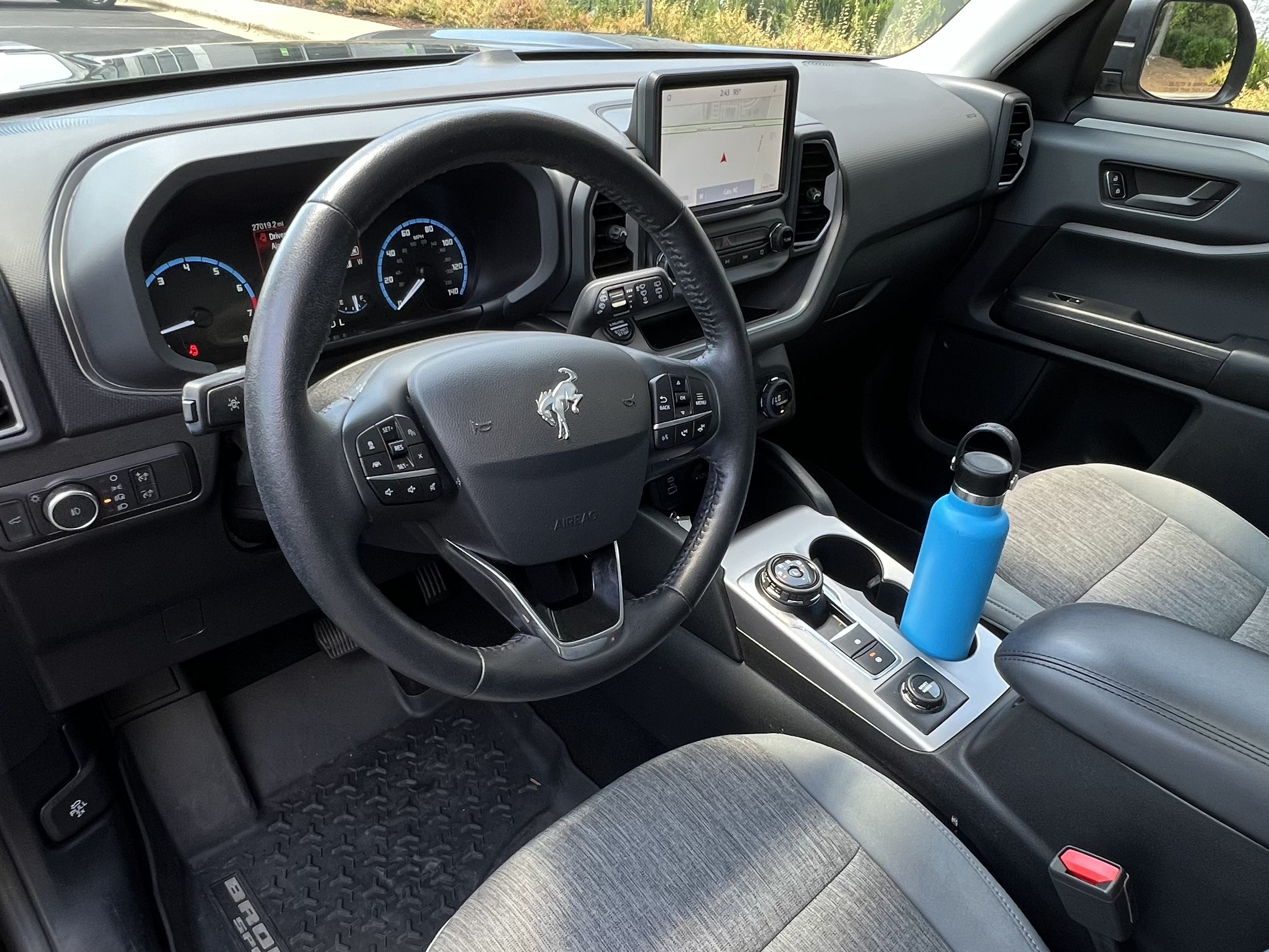

The Bronco Sport’s interior is also decidedly utilitarian, but that’s not a bad thing. Materials are generally on the less expensive side, but it’s important to remember the base Sport starts under $30,000. The leather-wrapped steering wheel feels nice and the three-tone upholstery gives the cabin some flair. The touchscreen isn’t overwhelmingly huge or sophisticated, but this version of Sync is easy to operate and I’m thankful for large physical audio and climate controls.
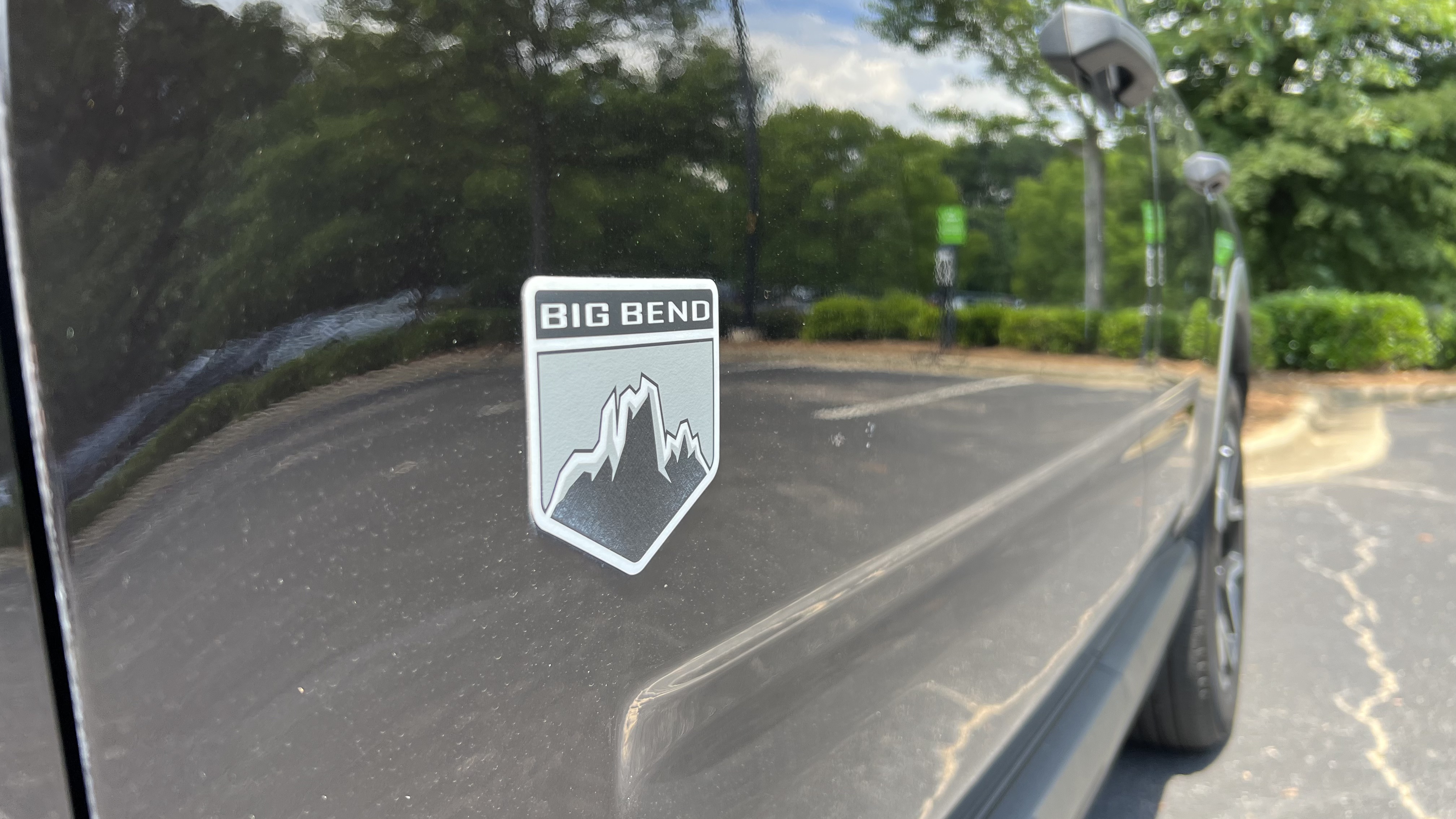
Even on this lower-end Big Bend model, features are plentiful. The driver has an eight-way powered seat, which is quite comfortable even though I do wish it had tilt adjustment. Both front seats are heated, and all passengers can enjoy the generously-sized moonroof. This example sports Ford’s CoPilot360 Assist+, which can be optioned on any trim and includes radar-adaptive cruise control, lane centering, and speed limit recognition. Blind spot monitoring, rear cross-traffic alert, and full LED headlights are also standard.
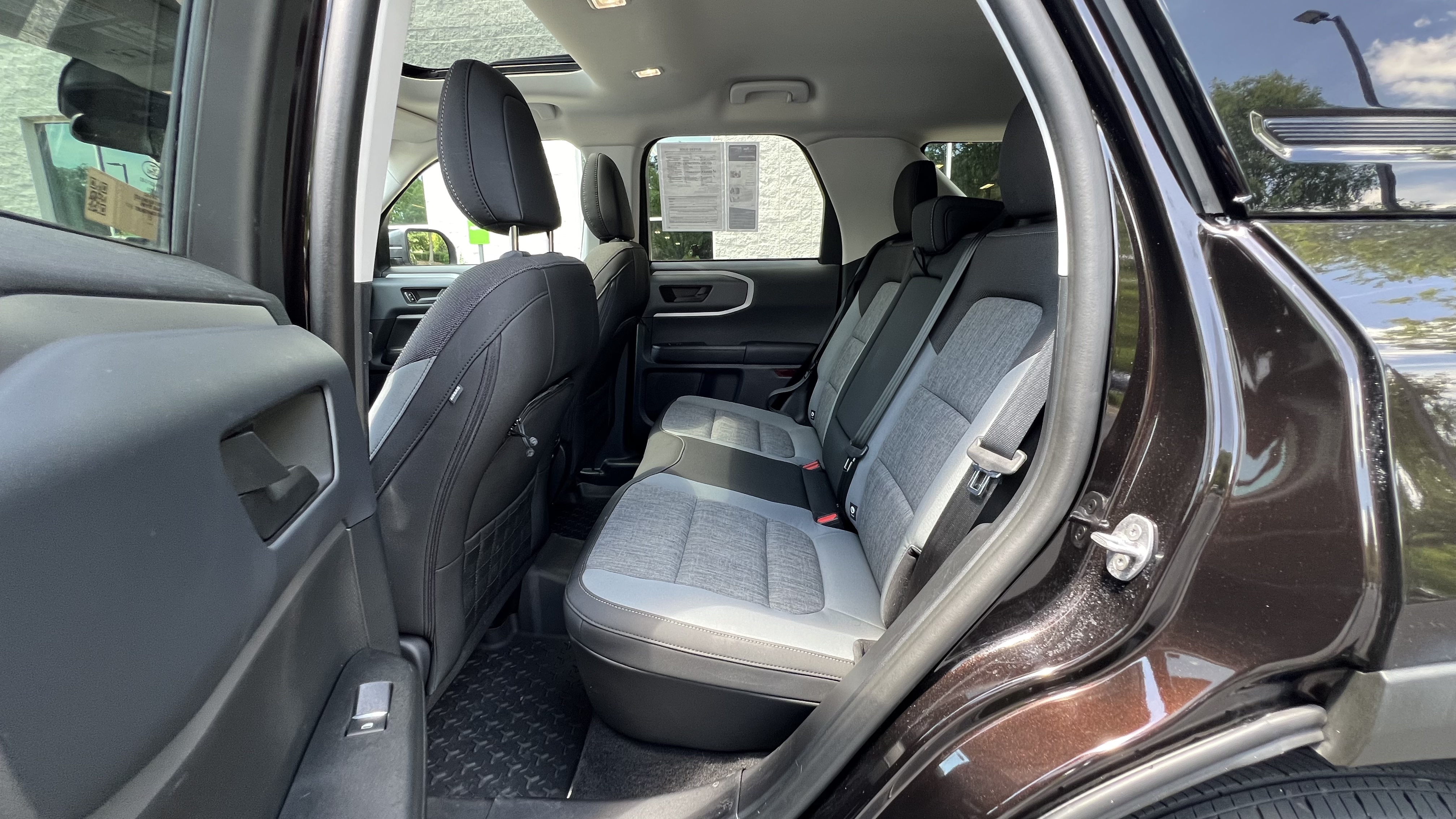
The Bronco Sport’s rear seat is slightly smaller than the Escape due to the shorter wheelbase, but cargo practicality is excellent thanks once again to the boxy shape of the vehicle. The seatbacks don’t fold perfectly flat, but you do have a foldable cargo shelf system to make separating items easier. There’s a neat hidden storage bin under the rear seat bottom cushion, just like a pickup truck. While the liftgate isn’t powered, you can open the glass separately which is a touch I always love, and there’s a bottle opener built in (just like the big Bronco!)
On the road, the Bronco Sport channels what the original Escape was going for 20 years ago, in that it looks and feels like a truck but actually drives like a car — and that’s a compliment. Road manners are just as composed as the current Escape, but the square hood gives a very commanding-feeling driving position. There’s also tons of headroom for passengers in both rows, so you can sit up pretty much as high as you want.
The turbocharged three-cylinder engine is a bit buzzy at idle just due to the nature of it being small, but as previously mentioned provides adequate passing power when moving. It also sounds fairly muscular under load. Part of me does wish Ford had opted to fit the Maverick’s hybrid system as standard instead, since the Maverick also shares Escape underpinnings. The three-cylinder’s fuel economy is once again adequate, but not overly impressive, whereas the base Maverick easily does 40 MPG around town. I suspect the Bronco Sport’s standard 4WD system was ultimately the deciding factor there.
Overall, while the Bronco Sport may not stack up to its bigger sibling off road, it’s a very thoughtfully designed crossover that really provides the best of both worlds. It truly succeeds at what Ford intended it to do. And not only is it arguably the coolest choice in its segment, it’s also a darn good value proposition for the more adventure-keen buyer.
| Vehicle Tested | 2021 Ford Bronco Sport Big Bend |
|---|---|
| Color | Kodiak Brown / Medium Dark Slate |
| Drivetrain | 1.5L turbo I-3, 8-spd automatic, Four wheel drive |
| HP / Torque | 181 horsepower / 190 lb-ft |
| Curb Weight | 3,467 lbs (est.) |
| 0-60 mph | 8.2 seconds (est.) |
| EPA Fuel Econ | 25 city / 28 hwy / 26 combined |
| MSRP | $36,150 |
 Also Andrew