
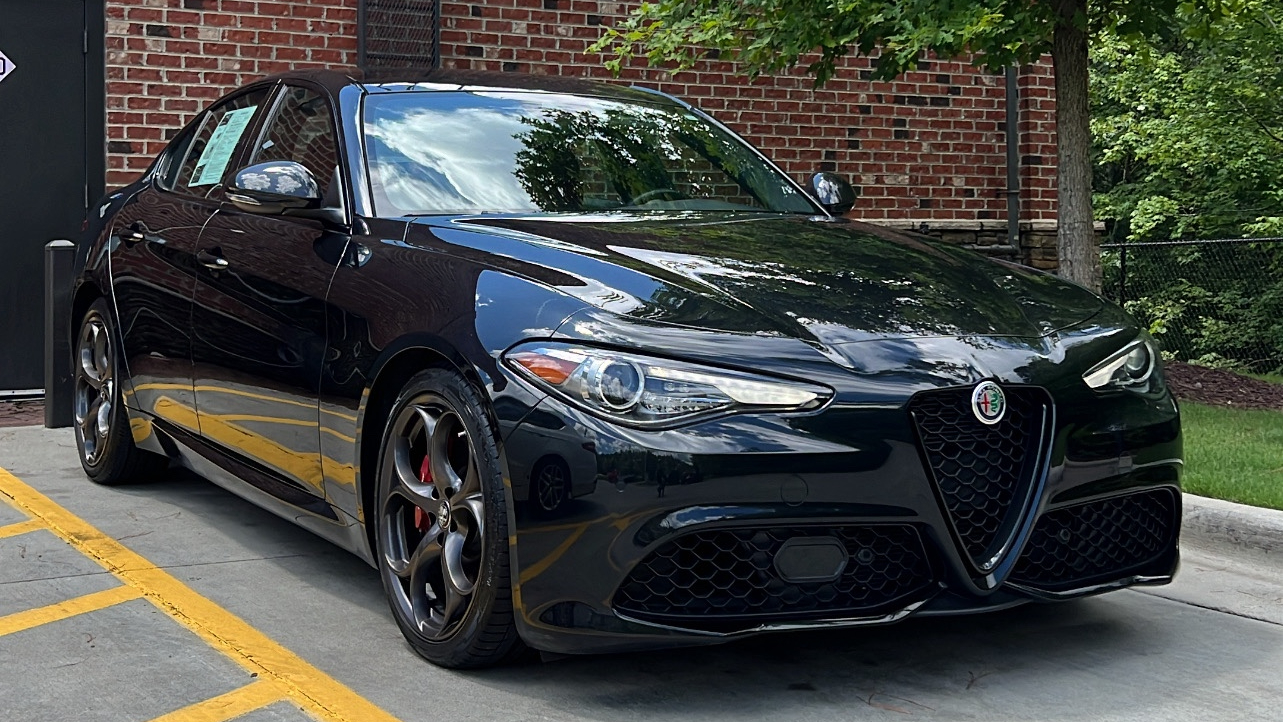
Over seven years after its debut, the Alfa Romeo Giulia is still a stunning car in many ways. Prior to the Giulia, Alfa hadn’t sold a mainstream car in the United States in over 20 years; the last being the 164 sedan leaving the market in 1995. It’s not the first Giulia, however, reviving one of the Italian brand’s nameplates from the 1960s and 70s.
Much like its ancestors, the Giulia was designed with sportiness being paramount. It’s one of very few cars that gives you the feeling of being designed from the top end down, rather than the other way around. The first model unveiled in 2015 was the high-performance Quadrifoglio, with a Ferrari-derived twin-turbo V6 and a driving experience that garnered unanimously favorable reviews.
Hopping into the more entry-level Guilia Ti Sport, tons of the QV’s great characteristics remain present. For one, while the 2.0-liter turbo-four doesn’t quite produce the bark of the 2.9-liter V6, what you get instead is still probably the most exciting exhaust note of all the competition. The equivalent Audi A4 or Lexus IS don’t come anywhere close to the noise of the Giulia, and I’d even argue the four-cylinder Guilia rivals the sound of the Genesis G70 3.3T I recently reviewed.
Chassis balance favors the rear end, giving the Giulia that perfect rear-drive feel; a little playful rotation in corners but without giving up front-end grip. The suspension remains an excellent balance of compliance, comfort, and control. The steering is heavy, but not overdone like BMW tends to end up with. Speaking of steering, the column-mounted metal paddle shifters are carried straight over from the Quadrifoglio, and almost make getting the Ti Sport package worth getting on their own, though you certainly can’t forget about the included limited-slip differential.
The Giulia’s 0-60 time of just over 5 seconds leads the four-cylinder competition, but that makes perfect sense since at 280 horsepower and 306 lb-ft of torque, it’s also one of the most powerful from factory. Even the rear-wheel-drive Giulia doesn’t struggle too bad for off-the-line grip, though unfortunately there’s no way to turn traction and stability control off as the Quadrifoglio is the only one to offer a “Race” mode on the drive selector. My other gripe comes at the other end of acceleration; the Brembo brakes can be incredibly touchy around town at lower speeds. Fuel economy is also on the lower end of the class.
On the outside, the Giulia Ti Sport is also incredibly similar to the Quadrifoglio. The gorgeous body lines and proportions remain; and save for extra exhaust tips and larger side skirts, splitters, and spoilers, the more basic Giulia is almost mistakable for the QV. Even the wheel design is identical, though they are naturally narrower on the four-cylinder version. I’m also quite fond of the spec of this particular car; the Nero Edizione package compliments the black paint with blacked-out trim and badges, and the dark silver wheels pair well with the red and white brake calipers.


Hopping inside, the Giulia’s cabin is just as stunning as the exterior, especially in the two-tone black and red of this one. The driver’s main touch points, the steering wheel and shifter, both feature perforated leather and red stitching to match. The front seats feature power-adjustable bolstering (as well as a thigh cushion extender) which both feel and look fantastic. Surprisingly, there’s less Fiat-Chrysler parts bin switchgear than in most Maseratis.
Still though, the actual interior quality has an underlying sense of traditional Italian craftsmanship — meaning it feels like it’s gonna fall apart as soon as Napoleon comes anywhere near it. Perhaps that’s why the ergonomics are also not entirely suited to taller people; my knees hit the lower dash too easily and the position of the B-pillar relative to the seat can make getting in and out a bit difficult.
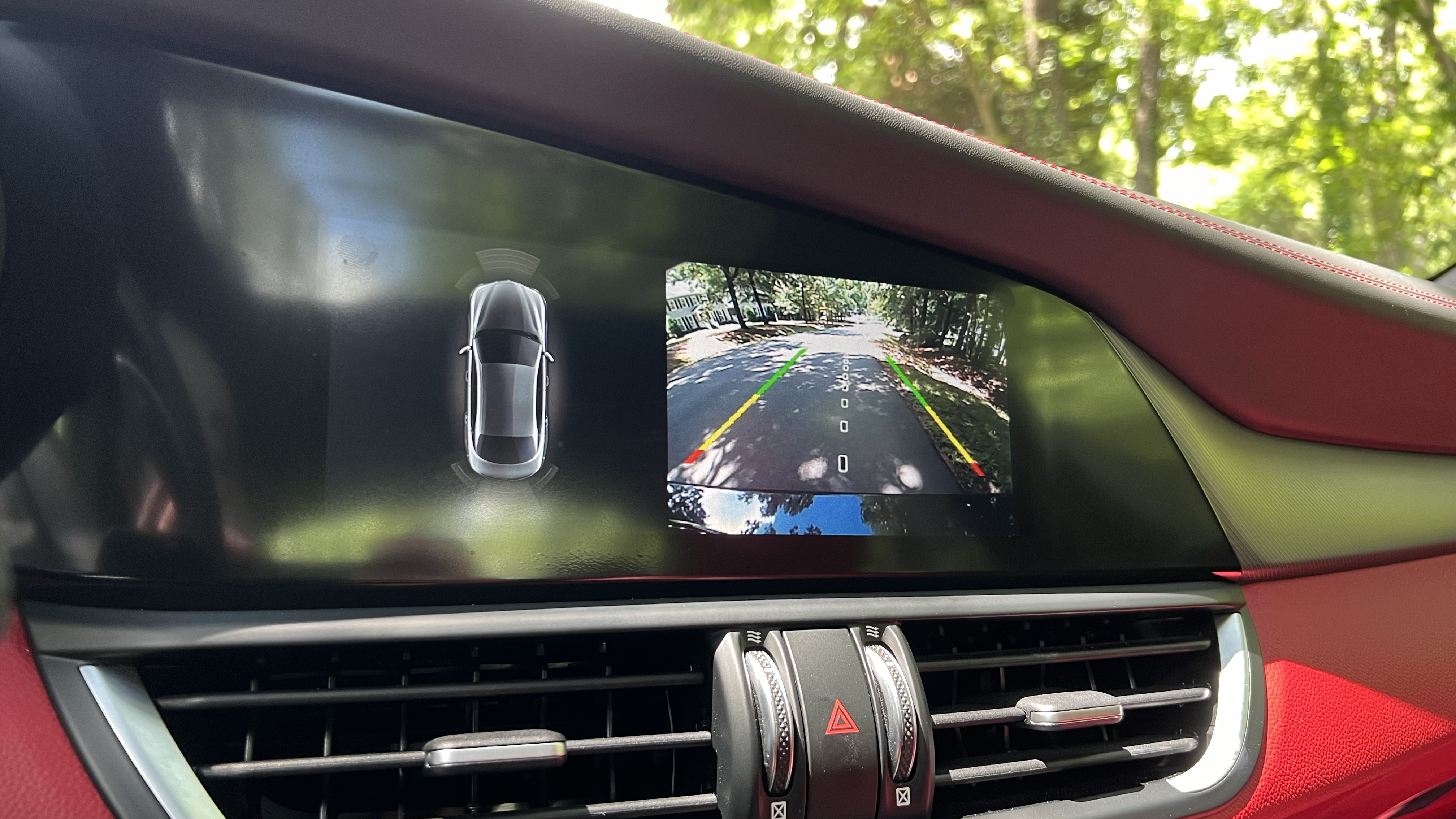
Joking aside, the Giulia’s interior feels fine, but nothing more. Technology is somewhat lacking from a usability standpoint, though is certainly improved from earlier models. The same can seemingly be said for the electronic gremlins that initially plagued the Giulia’s reliability. The interior received a minor facelift for 2020, bringing more safety features as well as a touchscreen infotainment display. The software is undoubtedly better, but there’s still some oddities, like why is the backup camera so small? At least the parking sensors display next to it, unlike earlier models.
In fairness, features are aplenty on this loaded Ti Sport. Front and rear heated seats are included along with a heated steering wheel, as are seat memory settings, power folding mirrors, rain-sensing wipers, and a dual sunroof. With the aforementioned 2020 update, more modern safety tech (such as automatic emergency braking, lane keep assist, and traffic sign detection) was made available, but unfortunately not standard. Either way, it’s still missing key things you’d expect from a car that was in the mid-$50,000 range brand new, like auto-dimming mirrors, a 360-degree camera, or maybe ventilated seats.
Ultimately, this just goes back to what I said before about the Giulia having the feeling of performance-focused design above all else. It’s so good from behind the wheel that it’s simultaneously a bit flawed when you pull back a bit. To its credit, it is the most unique, interesting, and genuinely one of the best-driving small sport sedans on the road, even without the Quadrifoglio’s extra craziness.
And it’s also worth considering that this example with just 12,000 miles on it is now available for nearly a 50 percent discount versus its original MSRP. I would still err on the side of caution and get an extended warranty, but even once you factor that into the cost, it still seems like a darn good deal. As it’s always been said, you can’t be a true petrolhead without owning an Alfa Romeo.
| Vehicle Tested | 2021 Alfa Romeo Giulia Ti Sport Nero Edizione |
|---|---|
| Color | Vulcano Black / Black & Red |
| Drivetrain | 2.0L turbo I-4, 8-spd automatic, Rear wheel drive |
| HP / Torque | 280 horsepower / 306 lb-ft |
| Curb Weight | 3,520 lbs (est.) |
| 0-60 mph | 5.1 seconds (est.) |
| EPA Fuel Econ | 24 city / 33 hwy / 27 combined |
| MSRP | $52,295 |
 Also Andrew
Leave a comment